


Choosing the right mobile app can be transformative for field service businesses. With so many options on the market, it’s tough to know which one suits your needs best.
Whether you’re shopping for a field service app for the first time or considering a switch from your current mobile solution, this article will help you narrow your options and understand what to prioritize.
We’ll cover the 11 core qualities that field service companies should seek in a field service management app, which include built-in AI and features that support contractors running both service and construction work. These insights are based on real-world experiences from the field service industry experts on our team — veterans running successful HVAC, plumbing, and electrical businesses.
Then, we’ll demonstrate how ServiceTitan incorporates these key qualities and list 15 other field service apps to consider.
Table of Contents
Want to see how ServiceTitan works to streamline your service business operations? Schedule a call to get a free, live, one-on-one walk-through of the features we describe throughout this article.
How to Choose the Right Software: 11 Things to Look For
Serving more than 100,000 contractors has taught us exactly what service companies need in a field service app. Here are the 11 qualities that matter most:
1. Organization and Ease of Use
A key benefit of using a field service app is to eliminate lost, sloppy, or disorganized paperwork. Apps should host and organize every relevant document and piece of information that your technicians need.
The app must also be user-friendly. If it isn’t, techs will often resort to their traditional handwritten paperwork, re-introducing the document management issues that an app is meant to solve.
2. Real-Time Access to Key Job and Customer Information
Apps should provide up-to-the-minute information about all current jobs, as well as detailed service histories and records of any previous work done for a customer that field workers can access while they’re on site.
If technicians don’t receive every document they need for a job, this can create delays or mistakes. In addition, if techs fail to review customer histories and past service reports, they can mistake a longtime customer for a new one, or try to sell an upgrade for a product that’s already been installed. Both are surefire ways to harm customer relationships.
3. Centralized and Seamless Communication Between the Field and Office
Without a field service app, back-office and field staff often communicate in a variety of disconnected channels. They collaborate through miscellaneous calls, texts, and emails that make it difficult to track which messages have been received, as well as where to find relevant updates and job information.
A field service app should seamlessly centralize all communications between your office and mobile workforce, whether it relates to a technician’s status on the job, last-minute requests by customers, or on-the-fly schedule changes.
4. Sales Enablement
Field service technicians historically have not enjoyed the process of selling. They didn’t get into the trades to be salespeople, but to be trades people. And yet, service businesses want their techs in the field to spot upsell opportunities, increase average ticket prices, and contribute more to profitability of the business.
Your field service app should help solve each of these problems. It should make it easier for technicians to generate more revenue with automated, tiered pricing options that turn every job into an upsell opportunity, presented with the polish of a professional proposal.
5. Accountability Enablement
The nature of field service work means that once technicians leave the office, managers and business owners can only hope their technicians will follow best practices and standard operating procedures in the field. But relying on hope leaves room for shortcuts, mistakes, and missed opportunities.
A well-designed field service app should help foster accountability among technicians while they’re in the field, and also make it easier for techs to provide the best possible customer experience.
This can bring peace of mind to service teams and managers, allowing everyone to feel confident they’re following best practices.
6. Customer Experience
In a competitive environment, providing top-notch customer satisfaction is essential for maintaining and growing a customer base. As consumers have come to expect convenience and seamless customer experiences, it’s important to choose an app that’s easy for them to use, empowers them to make educated purchase decisions, and allows them to complete transactions on the spot.
7. Integrations With the Tools You Already Run
Most contractors already run accounting software, payment processors, and other business tools before they consider a field service app. If the app doesn't connect cleanly to what you're already using, someone in the office ends up re-entering the same data twice, and mismatches between systems start costing you real money at reconciliation time. Look for native integrations with the accounting and payment tools your business runs on, not a workaround that requires manual exports.
8. Security and Reliable Data Backup
Techs are entering customer information, payment details, and job data from the field every day. A mobile app should ensure that data is handled securely and backed up automatically, not stored in a way that puts your business or your customers at risk if a device is lost or a connection drops mid-job.
9. Offline Capability
Basements, rural properties, and older commercial buildings often have spotty cell service. A field service app that stops working the moment a tech loses signal isn't suited to trades work. Look for an app that lets techs keep working offline, capturing job details, forms, and payments, then syncs automatically once they're back in range.
10. AI-Powered Support in the Field
AI is no longer a nice-to-have option bolted onto a field service app. The best apps now use AI to help techs troubleshoot equipment issues on the spot, summarize job notes automatically, and cut down the paperwork that can eat into billable hours. This is one of the fastest-moving parts of field service software, so it's worth asking any provider exactly what's available right now, not what's on a roadmap.
11. Support for Both Service and Construction Workflows in One Platform
A growing number of contractors, especially in commercial and specialty trades, run mixed businesses: service work and installs or full construction projects, often for the same customer. If your field service app only handles dispatch and invoicing, your project and installation work ends up living in a second system, with its own logins, its own data, and its own blind spots. Look for a mobile app that lets techs and project teams manage service jobs and project-based work, like daily logs, project tracking, and job-site documentation, from the same interface.
Below, we’ll explain how ServiceTitan’s mobile app works to facilitate each of these key functions. We’ve also listed eight general purpose field service apps.
For more detail, we’ve also written detailed comparison articles on many of our top competitors, here.
16 Mobile Field Service Apps
ServiceTitan
ServiceTitan’s Field Service Mobile App, compatible with both Android and iOS operating systems, offers an intuitive user experience that techs love.

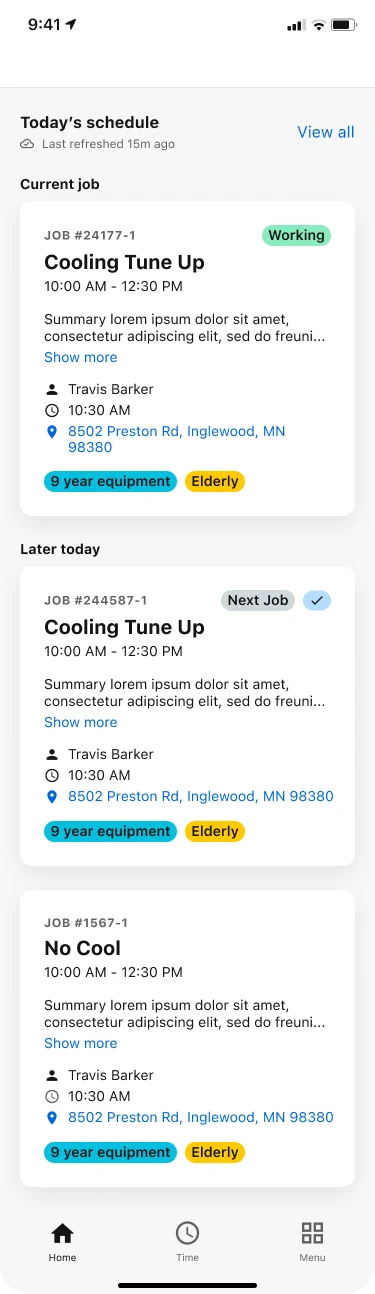
From the home screen dashboard, techs can quickly and easily see the jobs they have scheduled for that day, each presented as a job card with basic information such as:
Customer’s name
Scheduled date and time
Address
Arrival window
Tags identifying other key job information (e.g. potential member, replacement opp, etc.)
Then, each card can be tapped to pull up a dedicated page with further details about that job. This page will display further information such as:
Detailed work order descriptions
Distance to the job site
Ability to get directions
Access to the call recording between the office staff and customer

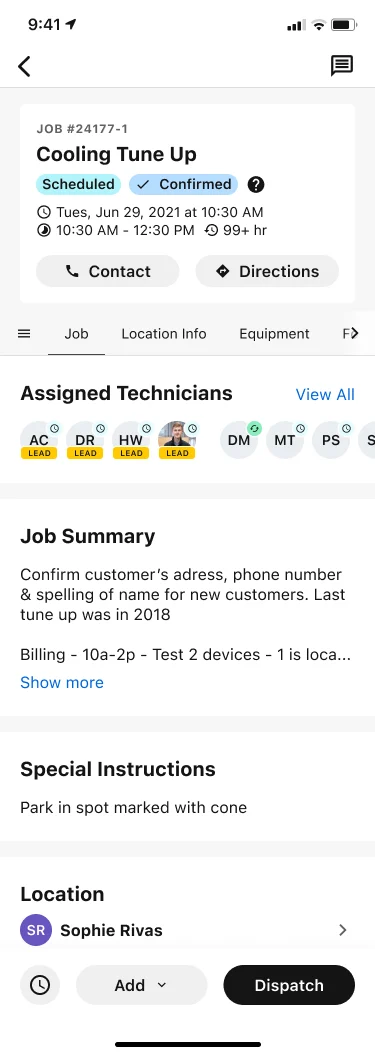
And as the job progresses, any new assets that are created, such as images of the job site or installation, recommended estimates, pinned notes, or purchase orders, are automatically stored through that page, easily accessible at any time (by anyone in the company who may need to see them).
If enabled, techs can dispatch themselves when they’re ready to head to the job, and office staff will receive automated notifications as they reach the job, begin work, or complete work. Alternatively, businesses can adjust settings so only dispatchers, office staff, or certain team members have the ability to dispatch techs.
From each job page, techs can also access the other essential tools they need throughout the lifecycle of a job. Via the left sidebar, they can view and utilize:
Customer History: Techs can see previous estimates, recurring services, existing equipment, previous invoices, photos, and videos from previous jobs, and more.


Job Forms: Techs can access digital forms that require customer signatures such as warranty agreements, as well as forms that foster accountability and better customer service (such as service and installation checklists, or pre-appointment customer experience checklists).

Estimates: With seamless pricebook integration, techs can build attractive estimates and multi-option proposals on the fly, right from their mobile device. Or they can select and customize pre-built estimate and proposal templates built by the back-office team. (We’ll discuss this more below.)
Invoices: Techs can easily generate invoices and send them to customers in a variety of ways.
Closeout: Once they complete a job, techs can accept payments on the spot from customers via check or credit card.
Notably, our app has offline capabilities, so all of these features and workflows are available even when techs are outside of zones with cell service or internet connectivity (a key feature that not all software solutions offer).
Mobile Estimates & Selling Tools
Now, let’s zoom in on our mobile estimates feature as it plays an integral role in many key facets of a field service app: tech experience, customer experience, sales enablement, etc.
From the estimates tab, you can view any previous estimates that have been quoted to that customer, or create a new estimate for that specific job. When creating a new estimate, you can use a template or configure it from scratch by selecting items from your pricebook.
The pricebook categories and search bar make it easy to find what techs are looking for, and each item can be tapped to see more relevant information about that product. For example, detailed product descriptions, flat rate price, member price, pictures and videos, and warranty information.
Techs can then tap “Add to Option” to add that equipment to one of their estimates in a Good-Better-Best-style proposal.
Once a proposal is ready, techs can tap “Present” to enter a presentation mode built for providing a clean yet detailed customer experience, while also taking the burden of “selling” off of the technician.


Customers can tap into each option for more details, view pictures of equipment, and even see rebate and energy savings data. Once they’ve selected the right option for them, they can apply for financing through one of our financing partners, if desired, or close out on the spot.
At that point, field technicians can collect payment however customers want to pay, whether through digital payment, check, or credit card. (They can scan checks right from the mobile application, reducing your need to visit the bank to deposit checks.)

When the job is done, dispatchers are automatically updated on their tech’s status, and techs can move on to their next job (or take their break, follow up on unsold estimates, clock out, etc.).
Atlas: AI Built Into the Field Experience

ServiceTitan's mobile app also includes Atlas, our AI field assistant built directly into the platform. Rather than a separate chatbot bolted onto the software, Atlas works with the same job, customer, and equipment data techs already see on the job.
In the field, techs can ask Atlas real-time questions and get answers pulled directly from ServiceTitan's own data, without stopping to call the office. With ServiceTitan’s add-on Field Pro product, Atlas can also pull details straight from equipment manuals, spec sheets, and installation guides, so techs aren't stuck flipping through paperwork or waiting on hold with manufacturer support. Techs can also ask Atlas to help troubleshoot and diagnose a problem, including built-in diagnostic tests and calculators, right from the app.

This closes the two most common ways a job stalls in the field: waiting on someone else for an answer, or guessing.
Manage Construction and Project Work From the Same Mobile App

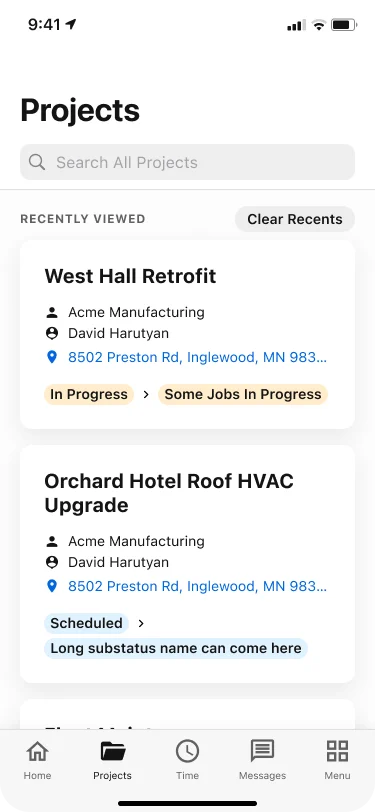
For contractors running both service work and construction projects, ServiceTitan’s Field Service Mobile App doesn't require a second system. From the job site, techs and project teams can view and search active projects, including statuses, descriptions, scheduled jobs, and key project details. They can capture and manage job site photos, videos, and attachments, and complete daily reports, logs, and RFIs directly from the field.
The app also handles labor tracking for project work: clocking in and out, viewing personal timesheets, managing time for other crew members, and adding workers to a project or job even if they weren't originally assigned. Crew members can collaborate in real time through threaded messaging across jobs, projects, and tasks, tagging teammates or emailing external stakeholders like insurance adjusters when needed. Project teams can also stay aligned on assigned tasks and track open opportunities or unsold estimates without leaving the app.
For hybrid contractors, meaning businesses running service calls and installs or full construction projects side by side, this means one login and one data set instead of switching between a field service app and a separate project management tool.
The #1 newsletter for the trades.
Want to See These Features in Action?
In reality, ServiceTitan’s mobile app is just one side of a more holistic field service management software, which also includes extensive desktop features for business owners, CSRs, dispatchers, and managers.
For a live, one-on-one walk-through of the work order management features we’ve discussed throughout this article, and a look at how the mobile and desktop sides of our platform work together, schedule a free demo today.
Housecall Pro


Housecall Pro is a mobile field service management platform built for home service businesses. It covers scheduling and dispatching, estimates, invoicing, and QuickBooks integration, along with online booking and customer communication tools.
It's designed primarily for smaller to mid-sized residential trades, HVAC, plumbing, electrical, and cleaning businesses, looking for an easy-to-implement, all-in-one tool.
Service Fusion


Service Fusion describes itself as an “All-In-One Field Service Management Software,” with a focus on providing core functionality at a lower price point. It offers estimates, invoicing, customer management, scheduling and dispatching, and GPS fleet tracking.
It's aimed at smaller field service businesses that want essential FSM functionality without paying for the deeper reporting or automation found in more full-featured platforms.
For more details, check out our complete comparison article: Service Fusion vs. ServiceTitan
FieldEdge


FieldEdge is a field service management software built for HVAC, plumbing, and electrical service businesses, with functionality for quotes and invoicing, scheduling and dispatching, and service agreements. It also offers project management tools for contractors handling longer-term jobs.
It serves both residential and commercial service businesses, with features built for each: Google Local Services Ads integration and capacity planning on the residential side, customer-specific pricing and native equipment tracking on the commercial side.
For more details, check out our complete comparison article: FieldEdge vs. ServiceTitan
Successware®


Successware® is a business management platform for the trade industry, serving HVAC, electrical, plumbing, and other trade businesses. Its platform covers call booking, CRM, dispatching and scheduling, and a mobile app for field technicians.
It's geared toward established trade businesses that want a system spanning both office and field operations, with reporting built around service agreements, call conversion, and technician performance.
For more details, check out our complete comparison article: Successware® vs. ServiceTitan.
Jobber


Jobber is a field service management app for home service companies, covering scheduling, dispatch, quoting, and invoicing. It integrates with QuickBooks and includes offline visit notes that sync automatically once techs are back in range.
It's built primarily for smaller residential trades, cleaning, landscaping, lawn care, and pest control, rather than larger, growing operations running commercial or construction work alongside service.
For more details, check out our complete comparison article: Jobber vs. ServiceTitan
Kickserv


Kickserv is a field service management platform offering a mobile app for technicians alongside a web app for office and back-office teams, supporting job management, scheduling, and workforce management. It supports both large and small businesses across a range of field service trades.
It's positioned as a general-purpose FSM tool rather than one built around a specific trade or business size, which makes it a common starting point for smaller operations before they outgrow it.
For more details, check out the feature comparison chart on our comparison page: Kickserv vs. ServiceTitan
ServiceTrade


ServiceTrade is a field service software built specifically for commercial mechanical and fire and life safety (FLS) contractors. It offers scheduling and dispatching, a mobile app for technicians, and analytics for business management.
Its focus is squarely commercial, without much built out for residential service work, which makes it a fit for contractors running purely commercial operations rather than hybrid shops.
For more details, check out our complete comparison article: ServiceTrade vs. ServiceTitan
ServiceMax Go


ServiceMax is a field service management platform built for asset-centric, enterprise field service operations, with asset management at the core of its platform, including Asset 360 for Salesforce, ServiceMax Core, ServiceMax FieldFX, and ServiceMax Go, its mobile app for technicians.
It's geared toward large, asset-intensive industries like energy and industrial services, rather than the HVAC, plumbing, and electrical trades ServiceTitan is built around.
For more details, check out our complete comparison article: ServiceMax vs. ServiceTitan
CompanyCam


CompanyCam is an innovative app built for field service contractors that lets you capture every part of a project or job photographically via your mobile device. You can take unlimited photos, annotate them with arrows, comments, and tags, and organize them by project which can be shared with your team and customers in real-time.
All photos are location and time-stamped, which is a useful feature if an issue comes up, and stored securely in the CompanyCam cloud.
CompanyCam is a good choice for field service teams that need a photographic record of their projects.
Connecteam


Connecteam is a popular app that helps manage scheduling, tasks, and work hours for field service teams. Features include templates that allow you to build checklists and share schedules and notes with your mobile workforce that they can confirm remotely.
The app’s Time Clock feature allows team members to log precise work hours with the in-app clock or directly on digital timesheets. This lets you oversee attendance in real-time and receive notifications of late or missed clock-ins. Then, timesheets can be exported or integrated with payroll software like QuickBooks.
This is a good app for managing a small team of field workers, and there is a free plan for up to 10 users, but you will need separate software solutions for estimating and invoicing.
Dynamics 365


Dynamics 365 Field Service is Microsoft's field service management app, covering work order management, scheduling, and asset tracking, backed by a mobile app for technicians. The mobile app is offline-first, and Microsoft has recently introduced a redesigned interface for common workflows and Copilot AI features that help technicians find and update job information without leaving the flow of work.
Like Salesforce, it's a strong option for businesses already running on the Microsoft ecosystem, but it comes with the same tradeoff: getting real value out of it requires backend setup and customization work rather than working well immediately out of the box.
FleetSharp


FleetSharp is an app for tracking commercial vehicles. Powered by Google Maps, the app gives you accurate locations of your field service trucks along with street view and interactive traffic reporting.
Features include the ability to see the truck’s current location as well as the direction and speed it is traveling. This lets you view the nearest driver to any location, which is useful for emergency call-outs when you need to dispatch a tech quickly. You can also create custom geofences to receive alerts when vehicles enter or exit a location (e.g. a job site).
The app will send you automatic alerts so you can monitor the maintenance of your vehicles (e.g. tire rotation and warranty information) as well as whether your field workers are driving safely (based on speeding, rapid acceleration, and harsh braking).
This app is a good option for field service companies with large fleets of service trucks that are looking for specific fleet management features.
Note: ServiceTitan’s add-on product, Fleet Pro is a commercial fleet management solution built directly into the platform. Fleet Pro helps you track every vehicle and asset in real time, automate payroll reconciliation with GPS data, and keep your fleet on the road.
RazorSync


RazorSync is a full-featured field service management app that offers scheduling, dispatching, time tracking, invoicing, and payment collection.
The app provides GPS tracking, automatic messaging for techs and customers, and integrates with QuickBooks. RazorSync lets you assign non-urgent work with an open deadline, allowing field workers to get to it when time is available. You can also assign small tasks (such as picking up a tool) for when techs have free time in their schedule.
The “clock in clock out” function means that employee hours and locations can be monitored and logged for accurate payroll spending.
Salesforce Field Service: Best App for Salesforce Users


Salesforce Field Service is Salesforce's dedicated field service mobile app, built on top of Salesforce Service Cloud. It's designed offline-first, so techs can pull up work orders, assets, and customer history even without a signal, and it includes built-in route optimization, inventory tracking, and electronic signature capture. Salesforce has also built Agentforce, its AI layer, directly into the mobile app, giving technicians pre-work briefs with customer and asset history and step-by-step troubleshooting guidance.
Because it's built on the Salesforce platform, it's a natural fit for businesses already standardized on Salesforce CRM. It does require a separate Field Service license on top of core Salesforce, and setup is typically more involved than a purpose-built field service app.
Read our post on the top CRMs here.
Skedulo Plus: Great Scheduling App for Field Service


As its name suggests, Skedulo Plus offers a ton of scheduling and dispatching features for “deskless” workforces such as healthcare, inspections, and social work. It is often described as a lower-cost alternative for companies on Salesforce who don't want to pay for Salesforce Field Service (see above).
With Skedulo Plus, you can view daily, weekly, and monthly schedules of allocated and dispatched jobs, view and edit job notes and attachments, and capture customer signatures while you’re at the job site. You can also view customer information, past jobs, and open the job address within native map applications to navigate to jobs.
Skedulo Plus also has a handy feature that suggests the most suitable field service worker for a job by qualification and availability. This helps you meet customer requirements by sending the right techs to the right service requests.
Schedule a free demo to discover how ServiceTitan can streamline your field service operations.


ServiceTitan Software
ServiceTitan is a comprehensive software solution built specifically to help service companies streamline their operations, boost revenue, and substantially elevate the trajectory of their business. Our comprehensive, cloud-based platform is used by thousands of electrical, HVAC, plumbing, garage door, and chimney sweep shops across the country—and has increased their revenue by an average of 25% in just their first year with us.


