A well-prepared construction bid package does more work for your project than almost anything else you’ll send out before groundbreaking. Get it right, and it pays off long after the bids come in.
Subcontractors and trade partners see the full scope of work to know exactly what they’re pricing.
Bids come back accurate and easy to compare.
Change orders and cost disputes drop.
You award the work to the right team at the right price.
But how do you put together a bid package that consistently meets these aims? That's where many project owners get stuck.
Every construction project comes with its own unique drawings, specifications, requirements, materials, labor needs, and owner expectations. If important details are missing or unclear, assumptions can quickly become expensive.
We’ve created this guide to help you build bid packages that attract the best bids. We'll also show you how ServiceTitan helps specialty contractors stay aligned with general contractors once work begins.
What Is a Construction Bid Package?
A construction bid package is the set of documents a project owner or general contractor assembles and distributes to solicit competitive bids from contractors and subcontractors.
It replaces verbal explanations with clear information on what the project involves, what contractors need to provide, and how the bidding process will work. Bidders use it to access project drawings, specifications, contract terms, and instructions for submitting the bid.
Bid packages benefit both sides. All bidders get the same project information, which helps them prepare accurate, competitive bids. This consistency also makes it easier for project owners and general contractors to compare what each contractor is offering for the price.
The #1 newsletter for the trades.
When are bid packages used in construction?
Bid packages are used whenever a project owner or general contractor needs to solicit proposals or bids from contractors or subcontractors before work begins. Specifically, bid packages are used:
During project procurement: Owners or general contractors use bid packages to collect and compare bids before awarding the work.
When selecting a general contractor: Project owners send bid packages to GCs competing for the project.
When hiring subcontractors: General contractors send bid packages to trade contractors bidding on specific scopes of work.
When work is divided by trade or scope: Commercial construction projects are often split into multiple packages (e.g., sitework, structural steel, mechanical). Subcontractors can bid on just their portion rather than the whole job.
On government or public works projects: Public projects often follow formal procurement and competitive bidding requirements, although the exact rules vary by jurisdiction.
For phased or fast-track construction: Early packages (foundations, structural) can go out to bid while the project owner develops later-phase drawings (finishes, interiors).
Why Are Construction Bid Packages Important?
Construction bid packages do more than help contractors price a project. They create a common reference point for bidding, awarding the work, and managing expectations once construction begins.
Other benefits include:
Accurate estimates: Detailed scopes, drawings, and specifications give contractors the information they need to price the work accurately. This reduces guesswork and helps prevent unexpected costs and change orders later.
Fair, apples-to-apples comparison: Standardized bid forms ensure every contractor prices the same scope of work. This makes bid leveling easier, so project owners can compare bids and identify the best value.
Clearer contract expectations: Including contract terms, insurance requirements, and bonding conditions helps both sides understand their obligations before work is awarded. It also creates a clearer reference point if a dispute arises.
Schedule control: Clear deadlines help contractors plan their work and submit bids on time. For fast-track projects, breaking construction into phases can also keep procurement moving and prevent delays to the overall project schedule.
Risk reduction: A complete bid package leaves less room for assumptions about scope, pricing, and project requirements. This can help prevent disputes, delays, and unexpected costs once work begins.
Public procurement compliance: On public projects, bid packages can help document the information bidders need to compete under applicable procurement requirements. Rules vary by jurisdiction, funding source, and project.
What Is Included in a Construction Bid Package?
The exact contents of a construction bid package depend on the project. However, most packages include the documents bidders need to understand the scope, price the work, and submit a complete bid:
Project overview and bidder instructions: A summary of the project, its goals, and timeline, along with clear guidance on how to submit a bid.
Scope of work and project specifications: Details about the work each contractor is expected to complete, including materials, quality standards, and other project requirements. A clear scope helps bidders price the same work and reduces gaps between bids.
Construction drawings and blueprints: Architectural, structural, and trade drawings that help contractors understand the project and calculate quantities, labor, and material needs.
Bid forms: A standard format for contractors to submit pricing, alternates, allowances, exclusions, and other required information. Using the same format makes bids easier to compare.
Submission deadline and delivery instructions: The exact date, time, and method for submitting a bid, such as through an electronic portal or in a sealed envelope.
Contract terms and conditions: Payment terms, timelines, dispute resolution procedures, and other responsibilities for both parties.
Insurance and bonding requirements: Proof of liability insurance, workers’ compensation, and bid/performance bonds bidders must carry or obtain.
Applicable wage and labor requirements: Any prevailing wage, labor, or workforce requirements that apply to the project.
Site access and safety requirements: Information about site conditions, access restrictions, working hours, and safety requirements contractors need to account for when preparing their bids.
Pre-bid meeting details: Information on any scheduled walkthroughs or Q&A sessions where bidders can clarify project details before submitting.
Point of contact: The name and contact information of the person bidders should contact with questions or requests for clarification.
Contract award process: An explanation of how bids will be evaluated and what factors will be considered when awarding the work.
Addenda: Any updates, clarifications, or changes issued after the original package was released, which bidders must acknowledge and incorporate.
Construction Bid Package vs. Bid Proposal: What’s the Difference?
A construction bid package and a bid proposal are two different parts of the bidding process. The project owner or general contractor sends the bid package to potential bidders. Contractors and subcontractors then submit bid proposals in response.
Bid Package | Bid Proposal | |
Definition | The set of documents used to request bids from contractors or subcontractors | The contractor’s or subcontractor’s formal response and offer |
Created by | Project owner or general contractor | Contractor or subcontractor |
Main purpose | Give bidders the information they need to prepare a complete and comparable bid | Explain what the bidder is offering, at what price, and under what terms |
Typical contents | Scope of work, drawings, specifications, bid forms, schedules, and project requirements | Pricing, proposed timeline, qualifications, exclusions, exceptions, and assumptions |
Construction Bid Package vs. RFP vs. Invitation to Bid
A bid package, request for proposal (RFP), and invitation to bid (ITB) all play a role in construction bidding, but they serve different purposes. The ITB or RFP invites contractors to respond, while the bid package provides the project information they need to prepare that response.
Here’s how they compare:
Bid Package | Request for Proposal (RFP) | Invitation to Bid (ITB/IFB) | |
Definition | A collection of documents giving bidders the information they need to understand and price the work. It is typically used as part of an RFP, ITB, or another solicitation process | A formal request asking contractors to propose how they would perform the work and at what price | A formal invitation asking contractors to submit a bid for clearly defined work |
Main purpose | Provide the scope, requirements, and documents bidders need to prepare their bids | Evaluate contractors based on price, approach, qualifications, and other project-specific criteria | Obtain competitive pricing for a well-defined scope of work |
Typical contents | Scope of work, drawings, specifications, schedules, bid forms, contract requirements, and instructions | Project requirements, scope, proposal instructions, evaluation criteria, and often supporting bid-package documents | Scope/specifications, bidding instructions, submission requirements, forms, deadlines, and supporting bid-package documents |
What bidders submit | A bid or proposal based on the package | A competitive proposal explaining price, approach, qualifications, schedule, and other requested information | A bid, typically focused on price and compliance with the stated requirements |
How submissions are evaluated | Depends on whether the package is being used with an RFP, ITB, or another procurement process | Usually based on multiple factors, such as price, qualifications, technical approach, schedule, and experience | Typically consider price, responsiveness to the bid requirements, and required bidder qualifications |
Opportunity for negotiation | Depends on the solicitation method | More likely; RFPs are commonly associated with negotiated procurement | Usually more limited in a formal sealed-bid process |
Best used when… | You need to give bidders enough consistent information to prepare comparable offers | The owner cares about how the contractor will solve or execute the project, not just the price | The scope and specifications are clearly defined, allowing contractors to submit comparable bids |
How to Prepare a Construction Bid Package
Preparing a construction bid package starts with making sure every bidder receives the same clear, accurate project information. From there, organize the documents, manage the bid period, and evaluate submissions consistently.
Here's how to prepare a construction bid package in five steps.
Step 1: Finalize the scope, drawings, and specifications
Before assembling the bid package, ensure the scope of work, drawings, and technical specifications are complete and consistent.
Check for gaps or conflicting information that could cause bidders to interpret the project differently. For example, if the drawings contradict the written specifications, contractors may price different requirements. This can make bids harder to compare and lead to questions and delays before they're even due.
Step 2: Assemble the administrative and legal documents
Gather all the documents bidders need, including bid forms, contract terms, insurance and bonding requirements, and submission instructions.
Then confirm the project schedule and important milestone dates. Bidders need this information to plan their labor, materials, and project sequencing. Clear contract terms and project milestones help bidders price the work more accurately.
Step 3: Compile the pricing documents and document checklist
If the project includes a bill of quantities (BOQ) or other quantity schedule, make sure it reflects the current scope, drawings, and specifications.
Also create a master checklist of all documents to be included in the bid package, such as drawings, specifications, addenda, and bid forms.
Step 4: Distribute and manage the bid period
Once the package is complete, send it to your list of bidders and keep track of who has received it.
During the bid period, record every question that bidders submit. If a section of the bid requires clarification, issue the answer through a formal addendum rather than sending a private email to one bidder. Recording and centralizing every question ensures that all bidders have the same information and an equal opportunity to price the work accurately.
Questions from multiple bidders can also reveal unclear or missing scope before bids are due, giving you a chance to correct the package through an addendum.
Step 5: Collect, log, and compare bids
As bids come in, record them using the same criteria for every bidder. Your bid evaluation process should take into account factors such as:
Scope coverage
Cost estimates
Experience and expertise
Project schedule
Contractor qualifications
Exclusions and assumptions
Compare each submission against the same evaluation criteria to make it easier to identify key differences.
For private projects, the lowest number on paper isn't always the lowest final cost. A bid that looks cheapest at award can still generate additional costs if missing scope, thin allowances, or vague exclusions surface during construction.
Public projects can be subject to specific award requirements, so follow the procurement rules that apply.
How ServiceTitan Keeps Contractors and General Contractors Aligned
A strong bid package establishes the project scope, pricing, and expectations before work begins. Once the contract is awarded, those details still need to stay connected to what happens in the field. This is especially important as questions, scope changes, updated documents, and progress billing come in.
ServiceTitan Construction Software gives specialty contractors one place to manage those workflows and keep general contractors and project stakeholders informed. Its construction project management tools connect project documents, RFIs (requests for information), change orders, daily activity, and billing, so that information isn't scattered across emails and spreadsheets.
Keep project documents organized and accessible
Bid packages can include drawings, specifications, contracts, permits, and other documents that construction teams continue referring to after work begins. Scatter those files across inboxes, shared drives, and local folders, and someone will end up working from an outdated version.
ServiceTitan’s document management tools keep all project files in a central location.
The Project Overview Dashboard is automatically created when a project is set up. It provides access to key project information and related documents, helping teams find the files they need as work progresses.

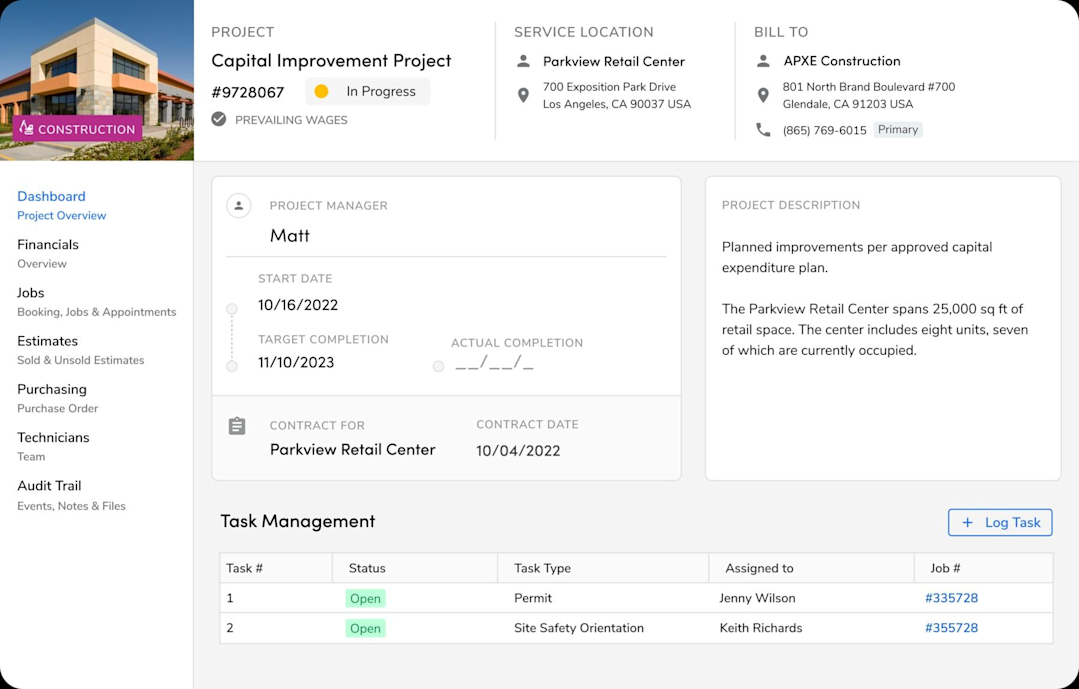
This helps specialty contractors keep original project requirements accessible and share relevant documentation with general contractors when scope or specifications raise questions.
Track RFIs and change orders through resolution
Even a detailed bid package cannot account for every question or change that comes up during construction.
Scope can change due to unexpected site conditions, revised drawings, or new requests from the project owner.
With ServiceTitan’s RFI and Change Order tools, contractors can create RFIs within the project record, attach supporting files, and track their status.

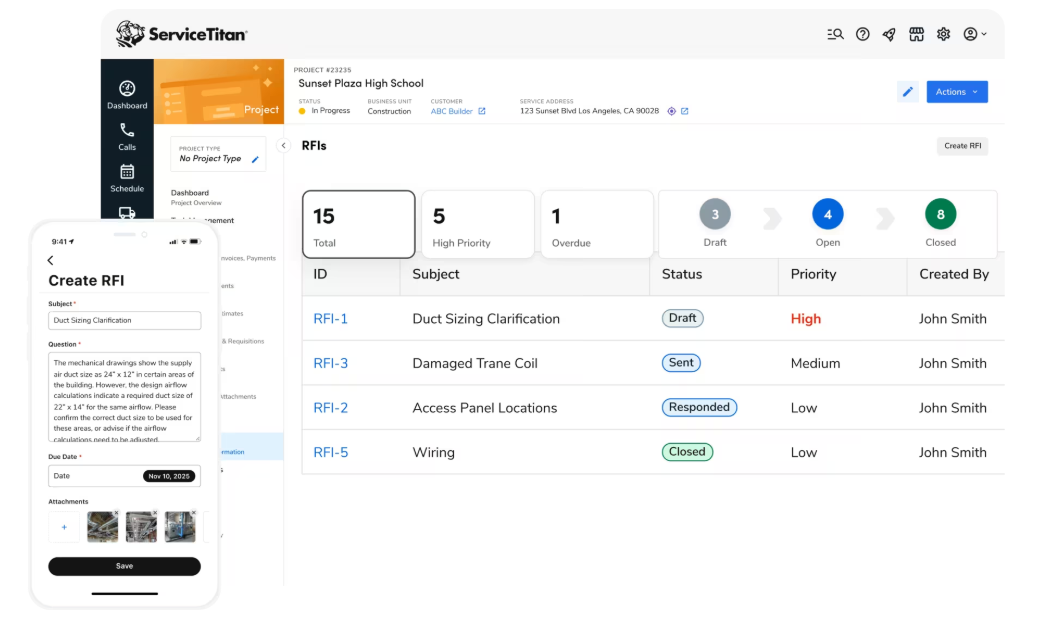
Contractors can also send change order requests to the customer or general contractor for review and track them from draft through approval or rejection.
Once a change is approved, ServiceTitan can update the contract value and project budget to reflect the revised scope.
This gives contractors a clear record of what changed, what was approved, and how each change affects the project budget. They can also share that information with general contractors without piecing together separate email threads.
Share clear updates from the jobsite
General contractors and project owners need regular updates on what's happening at the jobsite, not just a report when the project is finished.
ServiceTitan’s Daily Logs let field teams use photos and text to document information such as:
Labor hours
Materials and equipment used or received
Site and weather conditions
Safety issues
Field updates sync with the office, where teams can use them to prepare daily reports for general contractors and other project stakeholders.
This gives those stakeholders a clear, consistent record of daily progress. The same record can then support later reviews of RFIs, change orders, delays, or other project issues.
Keep progress billing tied to completed work
As construction progresses, specialty contractors need to bill completed work and account for any approved changes to the original scope.
ServiceTitan’s Progress Billing tools use the project’s schedule of values to track completed work. Subcontractors can use this record to create payment applications that follow general contractor and AIA billing standards.

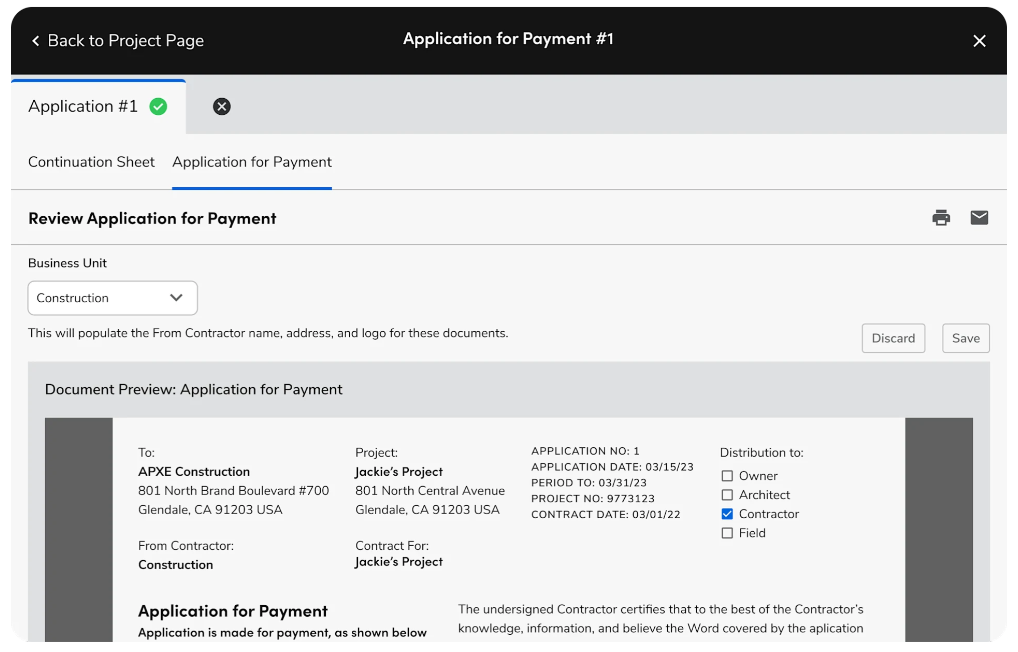
Additionally, all approved change orders automatically reflect in the schedule of values and appear in later billing cycles.
This helps general contractors and project owners see how the billed amount relates to the contract value and approved changes. Specialty contractors can also prepare payment applications without rebuilding the same information every billing cycle.
Over to You!
A strong construction bid package gives subcontractors the information they need to price work accurately and helps general contractors compare bids on the same basis. Clear scopes, drawings, specifications, and bidding requirements also reduce the risk of later gaps or misunderstandings.
After the project is awarded, that information should stay connected to the project.
ServiceTitan helps specialty contractors keep documents, RFIs, change orders, daily logs, and progress billing organized in one place. This makes it easier to share project updates with general contractors and keep both sides aligned on the original scope, approved changes, and billing.
If you want to keep bid information connected throughout the project, book a demo with ServiceTitan to see how it can help.
ServiceTitan is an all-in-one software solution designed for service companies looking to streamline operations, boost profits, and substantially elevate their businesses. Thousands of trade businesses across the country use our comprehensive, cloud-based platform, and it has grown their revenue by an average of 25 percent in their first year with us.


Frequently Asked Questions (FAQs)
Q1. What documents are included in a construction bid package?
A typical bid package includes the scope of work, drawings, technical specifications, project schedule, bid forms, submission instructions, and relevant administrative and legal documents. Depending on the project, it may also include a bill of quantities, prequalification requirements, and other supporting documents.
Q2. What is the difference between a bid package and a bid proposal?
A bid package is the set of documents a project owner or general contractor sends to prospective bidders with the drawings, specifications, and requirements they need to price the work. A bid proposal is the bidder's response, including pricing, schedule, qualifications, and any exclusions or assumptions tied to that specific bid.
Q3. Who is responsible for preparing a construction bid package?
Preparation typically falls to the general contractor, project owner, or a hired construction manager or architect, depending on the project delivery method. On larger commercial projects, an estimator or preconstruction team often assembles the package, while the owner's representative reviews and approves it before distribution.
Q4. What is a subcontractor bid package?
A subcontractor bid package is a scoped-down version of the full project bid package that covers only the trade-specific work a subcontractor is asked to price, such as electrical, plumbing, or HVAC. It includes the relevant drawings, specifications, and scope for that trade, rather than the entire project.
ServiceTitan Software
ServiceTitan is a comprehensive software solution built specifically to help service companies streamline their operations, boost revenue, and substantially elevate the trajectory of their business. Our comprehensive, cloud-based platform is used by thousands of electrical, HVAC, plumbing, garage door, and chimney sweep shops across the country—and has increased their revenue by an average of 25% in just their first year with us.