





Templates Guides
Plumber Helper Job Description + Free Template [2026]
 Plumbing
April 1st, 2026
ServiceTitan

![Plumber Helper Job Description + Free Template [2026]](https://images.ctfassets.net/3q1a0w8cwuwf/rUmmyS6c1NNk8PLyLSdGx/dad4c34cee1ad79a152618fa39b7cc80/plumber_helper_job_description_featured_image.png?w=4000&h=2250&q=85&fm=webp&bg=transparent)
A detailed plumber helper job description helps you attract candidates who understand jobsite expectations and daily responsibilities from day one.
This guide shows you exactly what to include in the job post to avoid confusion and wasted time during interviews.
We explain the entire recruitment process, including the essential duties, qualifications, skills, and physical demands of this role.
Save time by downloading our free template and tailoring it to your company’s workflow and standards.
Plumber Helper Job Description Template
A job description template helps you save time, define expectations, and set out key details, to avoid confusion during plumbing recruitment.
Download our free plumber helper job description template to create an explicit and complete job post in no time.
You can easily customize the template to match your business needs by adding or removing responsibilities and including company-specific requirements.
Before you get to work, let’s see what the plumber helper role actually entails.
What Does a Plumber Helper Do?
A plumber helper or assistant supports licensed plumbers during residential and commercial service work, reducing downtime and improving efficiency. Daily tasks typically include preparing jobsites, handling plumbing tools and materials, and assisting with basic installations and repairs.
This role serves as an entry point into the plumbing trade and provides hands-on exposure to real job operations under direct supervision.
Don’t mistake helpers for plumbing apprentices. Plumber helpers focus on general labor and support, while apprentices follow a formal training path including theoretical courses and documented work hours, eventually leading to plumbing licensing.
The #1 newsletter for the trades.
What Are the Primary Responsibilities of a Plumber Helper?
A plumber helper performs essential tasks that keep plumbing jobs organized, safe, and efficient from start to finish:
Assists with basic plumbing repairs and installations by measuring, cutting, assembling, and fitting pipes, fixtures, and water system components under the direction of a licensed plumber.
Prepares and restores jobsites by setting up work areas, marking pipe locations, protecting customer property, and cleaning the site after each service call.
Manages tools and materials by loading and unloading plumbing vans, organizing equipment, maintaining tools in safe working condition, and monitoring supply levels.
Supports system testing and inspections by checking new and repaired systems for leaks and proper operation using water or air.
Upholds company standards and safety practices by attending training sessions, following plumbing safety tips, wearing approved uniforms, and maintaining professional conduct on every job.
What Type of Training and Certifications Do Plumber Helpers Need?
Plumber helpers don’t require formal training or certifications because they perform support work, not specialized plumbing tasks. Most employers ask for a high school diploma or GED to confirm foundational knowledge, especially basic math used for measurements and material handling.
Some companies might request a plumbing trade school diploma because it shows exposure to basic plumbing concepts and tools, but this isn’t mandatory.
However, once a helper joins your plumbing team, you need to provide formal safety training to prepare them for the job and reduce risks:
First aid and CPR training enable plumber helpers to respond quickly to work-related injuries or on-site emergencies.
OSHA (Occupational Safety and Health Administration) training covers hazard awareness, proper tool use, plumbing PPE (personal protective equipment), and jobsite safety standards.
Fall arrest and confined space training applies to commercial and industrial work that involves heights, crawl spaces, or restricted access areas.
What Skills Are Essential for a Plumber Helper?
Plumber helpers need practical abilities to perform daily field work and personal qualities that improve teamwork and learning.
Technical skills
Plumber assistants use practical skills to handle tools, materials, and basic plumbing tasks under direct supervision:
Basic tool handling enables helpers to safely and efficiently use common hand and power tools, such as wrenches, saws, and torches, during daily work.
Familiarity with plumbing materials and fittings helps workers identify pipes, connectors, and fixtures to keep them organized and ready for installation.
Fundamental measurement and pipe preparation abilities support accurate measuring, cutting, and prepping of piping to match job requirements.
Basic math skills help with measurements, material quantities, and layout accuracy on jobsites.
Manual dexterity and coordination allow helpers to make precise hand movements when working in tight or confined spaces.
Valid driver’s license and clean driving record ensure safe travels between jobsites and responsible operation of company vehicles when required.
Soft skills
Plumber helpers rely on personal and interpersonal skills to work effectively with plumbing service technicians, office staff, and customers:
Ability to follow instructions helps assistants complete tasks correctly while working alongside licensed plumbers.
Efficient communication and teamwork improve task coordination and job performance, while reducing mistakes.
Attention to detail and problem-solving skills allow helpers to identify issues early, apply practical solutions, and maintain quality and safety standards on every job.
Adaptability and reliability guarantee consistent performance across changing job conditions, weather, and schedules.
Willingness to learn and grow encourages assistants to acquire new skills, seek training, and pursue a plumbing career.
What Are the Physical Demands of a Plumber Helper Job?
Plumber helper work requires constant physical effort throughout the day and comfort with hands-on labor in changing environments.
Include clear expectations in your job description to help candidates understand the pace and conditions of field work before applying:
Lifting and carrying heavy materials, like pipes, fixtures, tools, and equipment, requires strength and coordination to handle repetitive movement safely.
Working in confined spaces, such as under sinks, inside walls, or beneath buildings, involves frequent bending, kneeling, crouching, crawling, and reaching.
Sustained standing and walking during long service calls or full workdays calls for endurance to maintain focus and productivity.
Using hand strength and coordination for tool handling, pipe preparation, and detailed tasks requires steady control and grip strength.
Exposure to challenging work environments, including dirt, dust, moisture, noise, and temperature changes, demands safety awareness and physical resilience.
How to Hire the Right Plumber Helper for Your Business
Simply posting plumbing job openings is not enough to build a dependable team.
Follow this step-by-step guide to bring in candidates who match your business demands, learn quickly, and stay engaged as your company grows.


Step 1: Attract the right people
Hiring works best when your job post clearly explains daily responsibilities, expectations, and growth potential. Specific requirements not only attract candidates who understand jobsite realities, but they also reduce unqualified applications.
Promote the job opening through local trade networks, employee referrals, job boards, high schools, and community groups where people look for work. You can also reach out to past applicants who are already familiar with your standards.
Step 2: Evaluate candidates thoroughly
Interviews reveal more than experience alone, so include multiple evaluation methods to see how candidates think and work:
Practical questions, such as what tools are needed to remove a fixture, establish familiarity with equipment, measurements, and basic jobsite tasks.
Behavioral questions, like how to handle a frustrated client, reveal how candidates communicate, follow instructions, and interact with customers.
Hands-on assessments, such as measuring and fitting pipes, ascertain work habits and attention to detail.
Check out our plumber interview questions to get inspired.
Step 3: Onboard, train, and retain
Even the best candidates can fail without proper onboarding and training.
Start with a short trial period to observe the new hire’s work habits, reliability, and jobsite awareness in real conditions.
Provide constant training through hands-on practice and direct mentorship to help the plumber assistant learn tools, safety procedures, and workflow standards faster.
Use constructive feedback to keep performance aligned with expectations and encourage continuous improvement.
Increase retention by providing growth opportunities and recognizing the plumber helper’s achievements.
How Technology Empowers Plumber Helpers
Plumber helpers perform best when job information is clear, organized, and easily accessible.
ServiceTitan’s Plumbing Business Software connects scheduling, job tracking, field work, inventory, timesheets, and more in one system. This unified approach guides plumber assistants through every service call, streamlining workflows and reducing mistakes.
The software also comes with a Field Service App that equips helpers with a mobile workspace designed for field learning and efficiency. The app centralizes all essential information into a single interface, allowing new hires to focus on plumbing tasks instead of tracking down information or paperwork.
Now, let’s take a closer look at some of the features that make ServiceTitan one of the best plumbing apps and see how they benefit assistants.
Provides a complete job context before arrival
ServiceTitan’s mobile app gives your plumber helpers clear directions before the workday even starts. Schedules, customer notes, and recorded service requests explain what each service call involves and why the customer called.

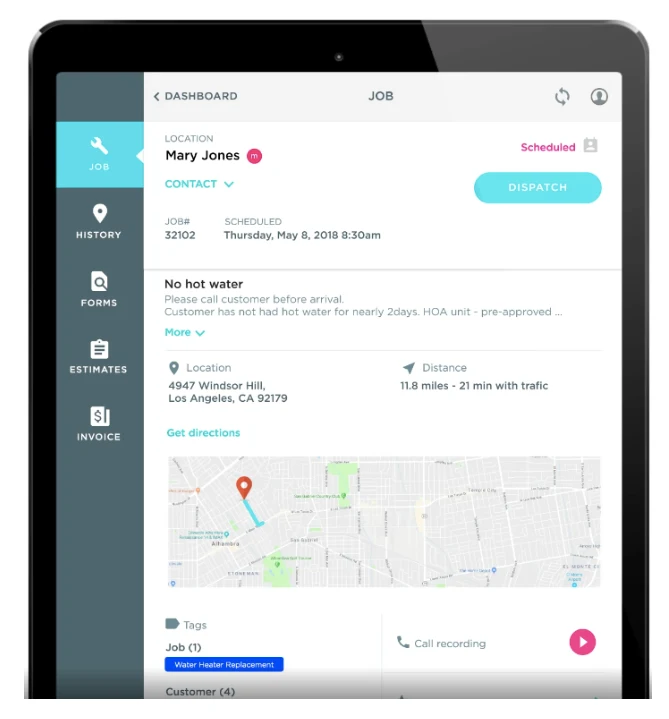
Assistants can also access previous work history and system details to anticipate the tools, fittings, and materials needed on-site. Better preparation shortens setup time and allows helpers to contribute immediately instead of waiting for instructions.


Simplifies job documentation
ServiceTitan’s Field Service App allows helpers to record job conditions as they happen. Photos of pipe runs, damaged components, or tight access points create visual references for licensed plumbers and office teams.


Notes and short videos provide context for completed work or identified issues. These records reduce miscommunication, prevent repeat work, and help assistants learn by reviewing real examples from past jobs.
Guides field work
ServiceTitan’s Digital Forms help plumber assistants follow standardized processes during every job. You can include checklists outlining preparation steps, safety checks, installation tasks, and cleanup requirements. The system can even make forms appear automatically on the helper’s screen to make sure they don’t miss any steps.


Improves on-site learning
The additional Pricebook Pro integration allows licensed plumbers to access supplier catalogs through the mobile app to show customers different product options and build on-site estimates.


Plumber helpers also benefit from this feature by seeing real products, materials, and system options used during active jobs. Product images, descriptions, and pricing make it easier to recognize parts, understand material differences, and learn how components fit into complete systems.
Improves accuracy
Helpers can also access ServiceTitan’s online plumbing calculators from their mobile devices to perform precise calculations while working in the field:
The pipe volume calculator helps determine how much fluid a pipe holds for drainage planning and system preparation.
The flow rate calculator helps measure how water moves through a system when you’re troubleshooting pressure or selecting components.
Over to You!
Well-crafted plumber helper job descriptions set the foundation for better hires, safer jobsites, and smoother daily operations. Use our free template and guidance to refine your hiring process and build a dependable team that supports long-term business growth.
ServiceTitan provides Plumbing Business Software that helps contractors run daily operations from one platform by connecting field work, office processes, and customer data in real time. The system includes scheduling, estimating, invoicing, inventory tracking, and reporting tools specifically designed for plumbing businesses.
Frequently Asked Questions (FAQs)
If you still have questions, these answers might help:
What tools and equipment does a plumber helper use?
Plumber helpers can use the same tools and equipment as licensed plumbers, but mostly under direct supervision or following precise instructions. Essential plumbing tools include wrenches, faucet keys, pliers, plungers, tubing and pipe cutters, hacksaws, and inspection cameras.
What types of systems does a plumber helper typically work with?
A plumber helper usually works alongside a licensed plumber on water supply and drainage systems found in homes and commercial buildings. Tasks typically include assisting with supply lines, drain and vent piping, fixtures, water heaters, and stormwater systems.
What is the average salary for a plumber helper?
According to Salary Expert, the average salary for a plumber helper is $20.34 per hour or $42,310 per year (correct as of March 13, 2026). However, wages differ based on experience and location.
What is the typical career path for a plumber helper?
A plumber helper typically begins by assisting with basic labor while learning from experienced plumbers on-site. Many helpers later enter a formal apprenticeship to undergo specialized training and required work hours. After earning a license, career paths can expand into licensed plumber roles, supervision, or running a plumbing business.


