Templates Guides
Gutter Proposal Template: Free PDF Download
 Gutter Services
August 19th, 2026
ServiceTitan


A gutter proposal is your chance to show customers that you’ve got what it takes to handle anything gutter-related. It outlines the scope of work and sets clear expectations on cost, materials, and timelines.
Gutter job proposal templates help you streamline the process, so you don’t create a different one for each job.
Templates provide a ready-made framework that takes the stress out of creating professional-sounding proposals from scratch, and can be used to quickly customize bids for residential or commercial gutter installations, repairs, or replacements.
You only need these key components:
Project description and property details
Scope of work and gutter specifications
Materials, pricing, and payment terms
Timeline, warranties, and terms & conditions
This article aims to explain everything about how to create the perfect gutter proposal template.
Why Do You Need a Gutter Proposal Template?
Because it streamlines your bidding process with homeowners while helping you present it in a clear, professional, and accurate manner.
The #1 newsletter for the trades.
Using a gutter proposal template gives you a reliable structure that ensures nothing vital is missed. It also:
Saves time: Allows you to quickly customize details like labor costs, material costs, and timelines, cutting proposal creation time dramatically.
Prevents costly errors: Reduces the risk of forgetting key information, like your company name, misquoting prices, or overlooking terms and conditions.
Ensures professional consistency: Consistent formatting and language reinforces your brand image and builds trust with clients.
Empowers faster client approvals: Makes it easier for clients to understand the scope of work and approve projects faster.
But a gutter proposal template sounds very similar to a contract. Are they the same thing?
Discover the answer in the next section.
What Is the Difference Between a Gutter Proposal and a Contract?
The main difference between a gutter proposal and a gutter contract is that a proposal aims to persuade customers to take your offer, while a contract is a legally binding agreement between parties to fulfill the job according to certain terms.
In short, a proposal is an offer that helps clients decide, whereas a contract formalizes that decision.
View this graph to see the difference:

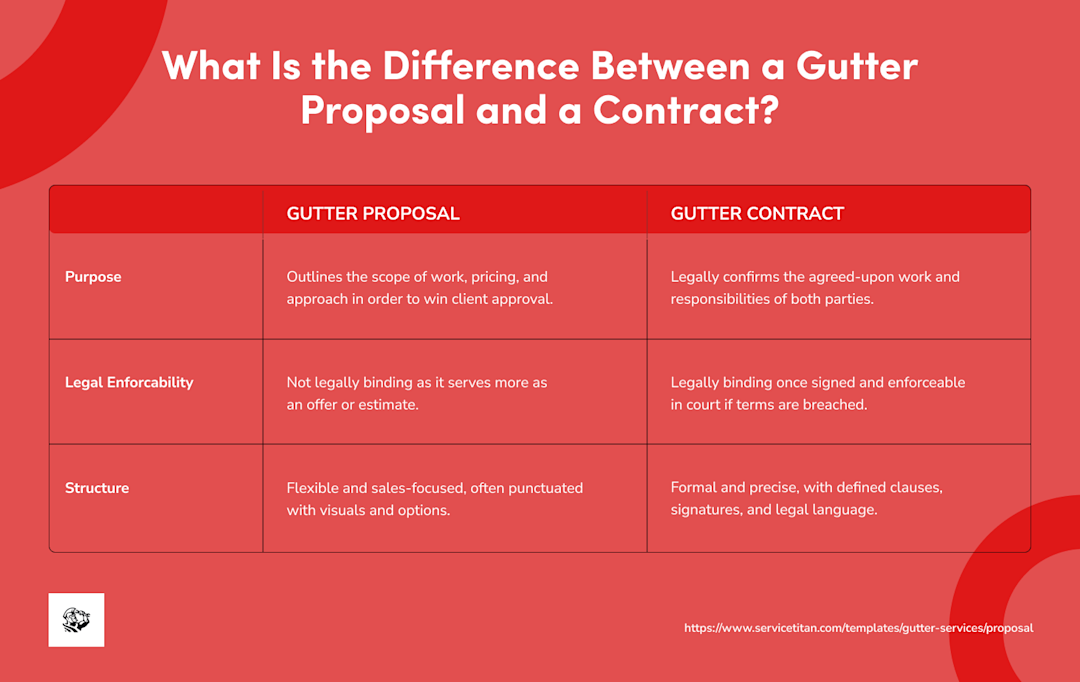
While contract templates must include legal language, what should you add to your gutter proposal template?
What Should Be Included in a Gutter Proposal?
Each section of the proposal should play a role in guiding the client through the project details while reinforcing your professionalism.
It should include the following:
Client and property information — Identifies the customer, service address, and contact details.
Project scope of work — Clearly explains the gutter installation, repair, or replacement tasks being performed.
Materials and specifications — Details gutter type, size, and material so customers know exactly what they’re getting.
Pricing and payment terms — Breaks down costs, deposits, and accepted payment methods for transparency.
Project timeline — Sets expectations for start dates, duration, and completion.
Warranty and guarantees — Explains coverage on materials and workmanship.
Terms and approval section — Outlines conditions and provides a space for client acceptance and signatures.
But how do you write a gutter proposal? Follow some simple steps, which we’ll talk about next.
How Do You Write a Gutter Proposal?
Writing a gutter proposal is about clearly communicating your solution while making it easy for clients to understand what you’re offering and ultimately say ‘Yes.’
To write an accurate and professional quote, follow these steps:
1. Start with client and project details
Start by adding client and project details to confirm who the proposal is for and where the work will take place, reducing the risk of confusion or costly mistakes later.
Make sure to include the client’s full name, property address, phone number, and email, along with the project date and job reference number. Follow this with a short project summary that describes the gutter issue or requested service, such as adding gutter guards or replacing damaged sections.
Referencing observations, including water damage or drainage issues, shows you’ve assessed the property and understand the client’s needs.
2. Define the scope of work clearly
Set expectations upfront to prevent disputes. A clearly defined scope helps the client understand exactly what services they are paying for and protects you from scope creep.
Start by describing each task in detail, such as installing new gutter systems, sealing joints, or disposing of old materials. Make sure to also specify what is included and what is not in the job.
Use simple descriptions and measurable details to ensure accuracy and avoid misunderstandings later.
3. Specify materials and methods
Clearly outline materials and installation methods. This reassures clients about the quality of work and eliminates guesswork since it’s based on specific choices rather than vague assumptions.
List the gutter type, size, material, and finish, and include downspout sizes, hangers, fasteners, and any add-ons like gutter guards.
Also, explain how the system will be installed, including attachment methods, slope for proper drainage, and cleanup procedures. This level of detail helps clients compare bids accurately and positions you as a trustworthy contractor.
4. Present pricing and payment terms
Make it easier for clients to approve your proposal by including the pricing and payment terms. This removes uncertainty and builds trust, while also reducing delays caused by follow-up questions.
To be as thorough as possible, break down the total cost into logical sections, such as materials, labor, and optional upgrades. Clearly state what pricing is a flat rate or based on linear footage. Include required deposits, payment milestones, accepted payment methods, and due dates.
Providing easy-to-read pricing helps customers understand the value of your work and minimizes disputes once the project is underway.
5. Include timeline, warranty, and approval
The final section of your proposal should contain an estimated date start, project duration, and any factors that could affect scheduling, such as weather or material scarcity.
In addition, outline warranty coverage for both materials and workmanship, including duration and limitations.
Conclude with an approval section that includes signature lines, dates, and acceptance terms. Making it easy for people to sign, either digitally or in print, helps you confidently begin work.
How Do You Customize a Gutter Proposal Template?
Submit your details in the form on the right and customize the template by adapting it to the specific project, client, and service type while keeping the core structure intact.
Customizing it ensures each proposal feels tailored, accurate, and relevant rather than generic.
Begin by updating client and property details, then adjust the scope of work to match the job, whether it’s a small repair or commercial installation. Add optional upgrades like gutter guards or oversized downspouts. Include your branding elements (logo, colors, and contact information) to reinforce your professionalism.
Finally, make sure to tailor timelines, payment schedules, and special terms to fit the project’s risks and requirements.
A well-customized template helps you stay efficient while delivering proposals that feel personal.
Last but not least, make sure you always keep your business details, such as your business name and contact information, up to date.
However, mistakes can easily creep in. Let’s see what you need to avoid.
What Are Common Mistakes to Avoid in Gutter Proposals?
Even experienced contractors can lose jobs or create disputes by overlooking small but critical details. Avoiding common mistakes helps you present clearer, more competitive bids, including:
Being too vague: Using generic language like “install new gutters” or “repair roof” without specifics can confuse clients and lead to disputes over what was included.
Incomplete pricing: Failing to break down costs or explain payment terms can cause hesitation and sow mistrust.
Missing exclusions or conditions: Not stating what’s excluded can result in scope creep and unpaid extra work.
Skipping timelines and warranties: Leaving out schedules or warranty details makes proposals feel unfinished and less professional.
Now that you know what common pitfalls to avoid, let’s talk about when to send these proposals.
When Should You Send a Gutter Proposal to Clients?
The perfect moment to send a gutter proposal is as soon as possible after completing a site visit, while the project details and client interest are still fresh.
It also shows professionalism and keeps momentum going.
Ideally, proposals should be sent within 24-48 hours of the inspection. This allows you to accurately reflect measurements, material choice, and any site-specific concerns with the customer.
Sending proposals early has another benefit: it positions you ahead of competitors who may delay their bids.
In short, fast, timely proposals increase trust, reduce follow-up questions, and significantly improve your chances of winning the job.
Next, we show you how ServiceTitan helps you streamline the gutter cleaning proposal process.
How ServiceTitan Supports the Gutter Cleaning Proposal Process
Creating accurate gutter cleaning proposals depend on reliable measurements, which you can easily miscalculate if done manually.
That’s why ServiceTitan is an ideal tool for removing guesswork from estimates and turning precise data into clear, client-ready proposals that build trust and confidence.
1. Accurate estimates from measurements
ServiceTitan makes this process fast and reliable by allowing contractors to quickly calculate linear footage, roof edge length, and access height directly within the platform.
With its Hover integration, ServiceTitan allows teams to capture detailed property dimensions without manual measuring or climbing ladders during the initial visit.
These tools help gutter cleaning companies estimate debris volume, labor requirements, and equipment needs with confidence. By eliminating guesswork, contractors can create proposals that are transparent and easy for clients to understand.
2. Consistent proposal templates
Consistency is key when quoting jobs professionally, and ServiceTitan gives gutter companies the tools to do exactly that. The platform includes an estimating tool designed to quickly build multi-option proposals to close deals, helping teams present structured, on-brand quotes every time.
Using a mobile app, technicians can present professional bids on the spot to win more jobs and raise average ticket size, without starting from scratch on each visit. The multi-option estimate builder equips your sales reps to close more jobs at higher average ticket values, increasing profit across your entire team.
Field crews can also upsell services through the dedicated mobile platform, making it easy to present add-on options in a consistent, professional format at the point of sale.
As a result, teams spend less time rebuilding quotes from memory and more time focusing on the value of their service — with every bid reflecting the same level of quality and professionalism.
3. On-site proposal presentation
With ServiceTitan’s ability to provide proposals onsite, techs can assess gutter conditions, document clogs, damage, or drainage issues, and build a complete proposal before leaving the property.
Technicians can capture measurements, photos, and notes in real time, which gives them the ability to recommend services on the spot.
This eliminates delays and follow-up emails that often stall decisions.
4. Easy payment and financing options
ServiceTitan helps gutter cleaning companies collect deposits and final payments directly on-site and generate invoices right from the proposal.
Even smaller jobs like routine gutter cleaning can benefit from immediate payment collection, so providing clients with convenient payment and financing choices can help contractors eliminate delays caused by invoicing back and forth.
If you’re interested in learning more about gutter cleaning apps, check out this article.
Over to You
Creating an accurate and professional proposal doesn’t have to be complex or time-consuming. Instead, by using precise measurements, templates, and on-site presentation, contractors can streamline their workflow and win more jobs easily.
ServiceTitan is a platform designed to help gutter cleaning companies manage proposals, scheduling, payments, and more from a single place. From generating accurate cleaning estimates to presenting professional proposals on site, ServiceTitan empowers you to run more efficient operations.