





When managed correctly, facility maintenance contracts provide steady income and open doors to long-term client relationships, but they also come with challenges.
That’s why you need to clearly communicate with clients, standardize processes, and use tools that streamline the entire process. Otherwise, what’s supposed to generate steady cash flow quickly becomes a source of revenue loss that can put you out of business.
To help you out, this guide offers insights from service businesses already using maintenance contracts, to explore:
Tips and best practices for winning, managing, and maximizing facility maintenance contracts.
Strategies for securing maintenance agreements with profitable terms.
How to track the performance of your maintenance contracts and enhance their profitability.
Let's get started.
What Is a Facility Maintenance Contract?
A facility maintenance contract is a written agreement between a property manager or owner and a service company that provides building maintenance services.
It covers things like:
What needs to be maintained (e.g., air conditioning, plumbing, lighting, cleaning).
How often the maintenance should happen (daily, monthly, or annually).
The standards or quality of service expected.
The #1 newsletter for the trades.
Why Are Facility Maintenance Contracts Important?
Facility maintenance contracts provide facility managers with a structured framework for maintaining the health of their buildings’ systems and infrastructure. It's an effective way to reduce operational risks and save costs.
For service contractors, these agreements create stable and predictable revenue streams while establishing clear expectations and defining the scope of work. Maintenance contracts enable contractors to:
Build long-term client relationships: Regularly visiting the same facilities helps you get to know clients and understand their buildings better. This creates opportunities to grow trust and become the first business they consider for larger projects.
Optimize resource allocation: When you know which buildings you'll be servicing and when, you can schedule your workers more efficiently and keep the right tools and materials in stock. This also lets you plan far into the future.
Demonstrate value and expertise: More service visits mean more opportunities to demonstrate your expertise and technical capabilities. This strengthens your market reputation.
Less scrambling: The more scheduled maintenance visits you have, the fewer emergency requests you’ll have to respond to. That allows you to work during normal hours instead of rushing out at 2:00 a.m. to fix emergencies.
Steady income: Instead of wondering where the next job will come from, contractors have regular work scheduled throughout the year. This makes it easier to pay employees and plan for the future.
Let's see how these contracts benefit facility owners and managers:
Access to expertise: Facility maintenance contracts give clients direct access to trained professionals with specialized knowledge. So, instead of relying on their in-house staff who may have limited skills, they can tap into a team of experts who stay updated with the latest regulations, technologies, and best practices.
Risk reduction: Facility maintenance contracts help reduce the risks associated with equipment downtime. When a professional contractor regularly inspects and services a facility, they catch small issues before they escalate. This reduces the chances of emergencies that could disrupt operations, damage properties, or endanger occupants or users.
Regular maintenance: Most facility maintenance contracts include scheduled preventive maintenance. This means that inspections, servicing, and minor repairs will be performed routinely—monthly, quarterly, or annually—depending on the agreement. And this regular maintenance helps identify small issues before they become major problems.
Vendor accountability: A formal contract establishes clear expectations and responsibilities of the service provider. This includes performance standards, response times, and quality of work. If the vendor fails to meet these standards, there are usually remedies outlined in the contract.
Cost control: These contracts offer predictable and controlled costs. They allow you to plan for maintenance expenses in advance, rather than having to deal with unexpected, expensive repairs or emergency service fees. And preventive servicing helps to reduce long-term costs by preserving equipment lifespan via consistent care and maintenance.
Single contact for emergencies: Facility maintenance contracts often provide a single point of contact for emergencies. Instead of calling multiple providers for different systems (HVAC, plumbing, electrical) you can contract one contractor to provide all the necessary resources and services.
What Are the Main Types of Facility Maintenance Contracts?
Facility maintenance contracts come in several types, each designed to suit different budgets and operational needs. The three most common (based on their tenure and visit cadence) are preventive maintenance contracts, corrective maintenance contracts, and full-service maintenance contracts.


1. Preventive maintenance contract
Think of this like regular checkups. The contractor visits on a set schedule to inspect and service your equipment before anything breaks down.
These contracts typically include routine tasks like system cleaning, part replacements, and safety checks. Your clients benefit from fewer emergencies, and you benefit from predictable work schedules and steady income. This model works especially well for critical systems like HVAC, elevators, and electrical panels, where downtime is costly for your clients.
3. Corrective maintenance contract
With this model, you only provide service when equipment fails. Your clients call you when something breaks, and you respond to fix it.
This can be a more appealing option for budget-conscious clients or those with non-critical equipment. However, it means less predictable revenue for you and more emergency calls. Ensure these contracts clearly define your response times, service call fees, and parts pricing to avoid confusion in the event of a breakdown.
4. Full-service maintenance contract
This is your premium offering. You handle everything for one annual fee—scheduled maintenance, emergency repairs, parts, and labor.
While these require more upfront planning and resource allocation, they offer the highest contract values and strongest client relationships. Your clients get complete peace of mind, and you get maximum revenue stability. These contracts are most effective when you have the capacity to serve as a client's single point of contact for all their maintenance needs.
What Should a Facility Maintenance Contract Include?
A solid facility maintenance contract clearly spells out what work you'll do, when you'll do it, and what your client can expect. This protects both you and your client from misunderstandings, ensuring everyone knows exactly what they're paying for and what they're getting.
Here are the essential elements every contract should include:
Scope of services: List exactly which systems you'll maintain—HVAC, plumbing, electrical, elevators, etc.—and how often you'll service them. Be specific. For example, ‘Monthly HVAC filter replacement’ is more specific than ‘Regular HVAC maintenance.’
Service Level Agreements (SLAs): Set clear expectations for your performance. How quickly will you respond to emergency calls? Two hours? Same day? When will routine work be completed? What quality standards will you meet? Put numbers to your promises.
Roles and responsibilities: Define who does what. Will you handle all the paperwork and compliance documentation? Does the client need to provide access or notify you of issues? Clear roles prevent finger-pointing later.
Pricing and payment terms: Spell out your fees, when invoices go out, and when payment is due. Include any additional charges for after-hours calls or parts not covered in the base contract.
Duration and renewal terms: State the contract length, how renewals work, and what happens if either party wants to end the agreement early.
Performance metrics and KPIs: Include measurable goals like equipment uptime percentages or work order completion rates. This shows your value and keeps you accountable.
Liability and compliance clauses: Protect your business with clear insurance requirements, warranties, and who's responsible for meeting regulatory standards.
Documentation and reporting: Outline how you'll track maintenance history and share reports with your client. Good records prove your value and help with renewals.
Creating and managing all these contracts manually gets messy fast as your business grows. You might forget to include important terms, miss renewal dates, or spend hours drawing up each agreement from scratch.
Many contractors try to solve this by hiring additional office staff to handle the paperwork—but that just increases your overhead costs.
Service agreement software like ServiceTitan eliminates this problem entirely. Instead of hiring more people or risking costly mistakes, you get a system that handles the heavy lifting for you—creating standardized contracts, tracking renewals automatically, and keeping everything organized in one place.
ServiceTitan's service agreement management software lets you quickly build standard contracts, then customize them for each client's specific needs.
Better yet, the platform automates renewal reminders, tracks your performance metrics, and shows you profit margins on each job—so you can focus on delivering great service instead of drowning in paperwork.


This allows you to maintain and grow your maintenance contracts without needing to hire more staff to manage paperwork, and prevents errors that erode your profit margins.
How Does a Facility Maintenance Service Contract Work?
A facility maintenance service contract is an agreement between a property owner and your maintenance company. Once both parties sign, you've locked in the services you'll provide, how often you'll visit, and the standards you'll meet.
From there, you organize your service schedule. Depending on the contract type, you'll make regular preventive maintenance visits to keep equipment running smoothly or respond to corrective maintenance calls when something breaks down.
Your client's primary responsibility is straightforward: to provide you with access to the building when needed.
At your end, you'll conduct inspections, complete the agreed work, and submit reports documenting your actions. Many contracts also include periodic performance reviews where you and the client check that you're honoring the Service Level Agreements (SLAs) you promised.
Managing all this manually—especially when you have dozens or hundreds of contracts—can quickly become chaotic. That's where tools like ServiceTitan come in.
ServiceTitan automates the scheduling process. You can bulk-schedule all your recurring visits at once based on each contract's frequency—monthly, quarterly, annually, or whatever you've agreed to. You can also assign your technicians based on who's available, so no visit falls through the cracks.

This means you consistently meet your SLA obligations, keep clients happy, and run a more efficient operation without the constant scrambling.
How Do You Choose the Right Facility Maintenance Contract?
The right contract structure depends on how predictable the work is and how much risk you're willing to take on. Your payment terms should match the project scope and your confidence level in estimating costs.
Here's a breakdown of the main contract types based on their payment terms and when to use each:
1. Fixed-price contracts
You set one total price for all the work upfront. No matter how long the job takes, the client pays the agreed amount—no more, no less.
You can use this when you know exactly what needs to be done and can accurately estimate your labor, parts, and time. This works well for standard preventive maintenance agreements where the tasks and schedule are clear—like a year-long maintenance plan for an office building with routine HVAC, plumbing, and electrical checks.
2. Cost-reimbursable contracts
The client pays your actual costs—labor, materials, expenses—plus a fee for your services. If unexpected issues pop up during the work, the client covers those additional costs.
Use this when you're walking into an uncertain situation and can't predict what you'll find. Be sure to keep detailed records of all expenses. This approach is particularly suitable for older buildings where hidden issues are likely, or for government facilities where transparency and thorough documentation are required.
3. Time & materials (T&M) contracts
You bill based on actual hours worked and materials used. There's no fixed total—costs vary depending on what each job requires.
If the scope keeps changing or isn't fully defined upfront, this contract type will be the most suitable. This gives your client flexibility to add tasks as needed without renegotiating the entire contract.
This is perfect for on-call service relationships—such as a retail chain that calls you throughout the year for various issues: clogged drains one week, electrical problems the next, and emergency repairs another time. Each visit is different, so T&M billing makes the most sense.
How Can You Get Facility Maintenance Contracts?
Learning how to build sustainable relationships with facility owners and managers is a great way to consistently win facility maintenance contracts.
Below are some strategies you can adopt to earn clients’ trust and win facility contracts:


1. Deliver reliable service
The easiest way to get maintenance contracts is to score renewals from those you already have. But no client will renew their contract if you deliver inconsistent service quality.
So, show up on time, do quality work, communicate clearly, and follow through on your commitments. Keep your SLA promises every single time.
When clients know they can count on you, they'll renew contracts and refer you to others.
2. Target ideal clients
On the surface, chasing every facility owner might be a great strategy to get more contracts. But you quickly realize it drains your time, spreads your team thin, and attracts customers who aren’t even profitable.
That’s why you should focus on facilities that match your strengths and expertise.
For example, if you specialize in healthcare facilities, target hospitals and clinics. If you're great with HVAC systems, go after buildings with complex heating and cooling needs.
Learn what matters most to each type of client. Hospitals need fast emergency response and strict compliance. Retail chains want minimal disruption during business hours. When you understand their specific pain points, you can pitch solutions that directly address their concerns.
3. Craft clear proposals
Your proposal should make it easy for clients to say yes. Clearly explain what you'll do, when you'll do it, how much it costs, and how you'll measure success.
Be specific about scope, timelines, and pricing—no vague language. Include testimonials or case studies from similar projects to prove you can deliver.
A clear, professional proposal shows you understand clients’ needs and have a solid plan to meet them.
4. Simplify billing processes
Complicated invoicing or limited payment options create friction and slow down your cash flow. They also discourage clients from renewing contracts due to the cumbersome nature of the payment process.
Tools like ServiceTitan automate billing, track accounts receivable, and offer multiple online payment options. With it, customers can pay via credit card, check, bank transfers, or cash. This improves the billing process and cash flow.


5. Network and engage
Most facility maintenance contracts are awarded based on relationships and reputation, not just price. So, get out there and meet the decision-makers.
Attend trade shows, join industry associations, connect on LinkedIn, and participate in online forums. Share helpful content that demonstrates your expertise—answer questions, post tips, show your work, and help others with strategies on growing their business.
When facility managers need a contractor, they'll think of you first if you've already built that relationship and proven your value.
How Do You Manage Facility Maintenance Contracts Effectively?
Managing your facility maintenance contracts well is how you keep clients happy, protect your reputation, and build long-term relationships that lead to renewals and referrals.
Here are practical strategies to stay on top of your contracts:


1. Track key performance indicators
You can't improve what you don't measure. Monitor the metrics that matter—profit per contract, job completion rates, response times, and technician efficiency.
Tools like ServiceTitan give you real-time dashboards showing which contracts are profitable, which jobs are running behind, and what parts you'll need for upcoming work. They also provide a breakdown of the actual and budgeted costs, helping you monitor profit.

This visibility helps you catch problems early before they upset clients.
2. Balance workload efficiently
When your team isn't stretched too thin, they do better work, and clients get better service. That’s why you shouldn’t overload your techs or leave them with too much downtime. Spread work evenly so everyone stays productive without burning out.
ServiceTitan's scheduling tools help you assign the right amount of work to each technician, maximize billable hours, and keep jobs on track. It shows you the amount of work assigned to each technician, allowing you to maintain a healthy workload, and lets you schedule jobs months in advance.


3. Maintain clear communication
Good communication builds trust. When facility managers see you're proactive and transparent, they view you as a partner invested in their building's success—not just another vendor. This leads to renewals and long-term relationships.
To maintain an open line of communication with customers, send regular updates, document your work, and suggest improvements before they become emergencies.
And to encourage feedback, always act on customer suggestions. You can use them to improve your processes, adjust schedules, or refine contract terms for even better results.
4. Standardize compliance processes
Create checklists, inspection forms, and safety protocols for every contract. This eliminates guesswork and ensures that your technicians complete every task correctly and safely.
Start by identifying what compliance means for each contract, then build clear step-by-step checklists your team can follow. This reduces errors, speeds up work, and ensures compliance with regulatory requirements.
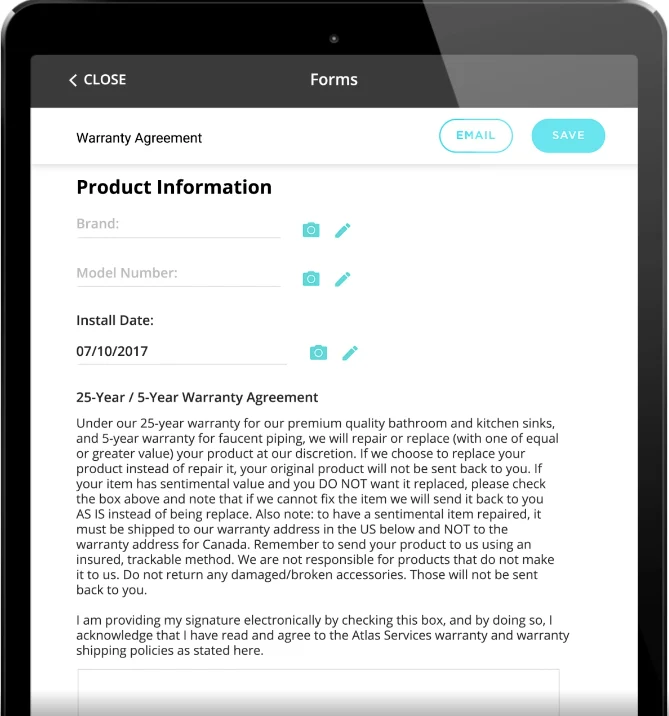
To ensure your techs actually follow these checklists, use ServiceTitan's Mobile App to digitize them. The app can automatically show checklists at specific job stages and won't let techs move forward until they've completed each step. This keeps everyone accountable and ensures nothing gets skipped.

5. Leverage data and reporting
Use automated reports to track each contract's performance—profitability, scheduling gaps, technician productivity, and trends over time. Data shows you where to cut costs, improve efficiency, and catch small issues before they become big problems for your clients.
6. Review and adjust regularly
Don't just set contracts and forget them. Conduct periodic reviews to ensure they're still profitable, fair, and meeting client needs.
Check service quality, track compliance, and identify any bottlenecks affecting performance. If pricing needs updating or the scope needs adjusting, handle it before renewal time.
ServiceTitan's Service Agreement and Contract Renewal features automate this process. The system handles renewals, updates expired payment methods, and enables auto-billing—so you don't lose revenue to manual errors or forgotten follow-ups.

What Are Common Challenges With Facility Maintenance Contracts?
Managing facility maintenance contracts can be challenging. When expectations aren't clear or responsibilities get murky, both you and your clients can run into problems that hurt service quality, blow budgets, and damage relationships.
The trick is to spot these issues early, before they cause real damage.
Here are common challenges to watch for:
Unclear scope of work: Vague contract language leads to confusion about what's included in your services. Be specific from the start.
Disputes over performance: Differing views on service quality or missed SLAs can cause tension between providers and clients.
Inconsistent documentation: Without good records, you can't prove what work you did or track your performance over time.
Budget overruns: Unexpected repairs or poorly planned pricing can blow through budgets and strain relationships with clients.
Communication breakdowns: When you don't keep clients informed during service work, delays happen, and frustration builds.
Recognizing these problems early—and having clear systems to prevent them—keeps your contracts profitable and your clients happy.
How Do Government Facility Maintenance Contracts Differ?
Government contracts come with more red tape than private sector work. Here's what makes them different:
Stricter bidding process: You'll need to submit detailed proposals through formal procurement channels. The government reviews multiple bids and selects the one that best meets specific criteria.
Heavy regulation: Expect to comply with OSHA safety standards, environmental regulations, and other federal, state, or local requirements. Non-compliance isn't just frowned upon—it can disqualify you or result in penalties.
Extra credentials required: Many government contracts require special certifications, background checks, or security clearances before you can even start work.
Detailed reporting: You'll document everything. The government needs transparency and accountability for how public funds are spent, so expect regular reports and audits.
Slower payments: Government payment cycles are typically longer than those of private clients. Budget for the wait times.
Performance-based renewals: Renewals often depend on audits and proven performance metrics. You need to document your results to keep the contract.
Additional requirements: Some contracts include special priorities, such as hiring local workers, using minority-owned subcontractors, or adhering to sustainable practices.
While government contracts can be more demanding, they also offer stable, long-term revenue if you can meet the requirements.
How Much Do Facility Maintenance Contracts Typically Cost?
Facility maintenance contract costs vary depending on the facility size, equipment complexity, service frequency, and contract type. Common pricing models include fixed annual fees, time-and-materials rates, and performance-based pricing.
Over to you
We've seen how facility maintenance contracts can create a steady income stream for your trade business. And with the right practices and tools, you can increase your chances of winning high-ticket maintenance contracts and retaining more clients.
With a platform like ServiceTitan, you can efficiently manage more contracts. The software helps you stay on top of scheduled service visits, monitor technician performance, and track contract profitability from a single dashboard.
Ready to take control of your facility maintenance contracts? Book a demo to see how ServiceTitan can help.
ServiceTitan is a comprehensive solution that helps trade service contractors to streamline dispatching, track technician performance, track profitability, and uncover new opportunities.
The platform is trusted by thousands of trade companies nationwide. ServiceTitan is built to increase efficiency, eliminate guesswork, and ensure you offer the best services to customers.


ServiceTitan Software
ServiceTitan is a comprehensive software solution built specifically to help service companies streamline their operations, boost revenue, and substantially elevate the trajectory of their business. Our comprehensive, cloud-based platform is used by thousands of electrical, HVAC, plumbing, garage door, and chimney sweep shops across the country—and has increased their revenue by an average of 25% in just their first year with us.


