


Homeowners today take cool air in the summer and cozy heat in the winter for granted, a standard comfort in many houses across the country. Behind every well-regulated home stands a skilled heating, ventilation, and air conditioning (HVAC) technician who makes it all possible.
Yet not everyone can benefit from indoor air comfort. This isn’t about affordability, but availability: there are simply not enough technicians.
The sad truth is that contractors and service businesses are struggling to find qualified techs, a shortage that’s reshaping the way the industry works.
In this article, we’ll unpack what’s driving the HVAC labor shortage, how it impacts business and clients, and what strategies leaders can use to attract and retain top talent.
What Is the HVAC Technician Shortage?
The HVAC technician shortage refers to the growing gap between demand for HVAC services and the number of qualified technicians available to deliver them.
In short, there are not enough HVAC technicians to fill this role. According to ACHR News, the HVAC industry is dealing with a shortage of 110,000 technicians, with around 25,000 leaving the workforce annually.
As a result, contractors struggle to hire skilled workers fast enough to meet the rising demand as experienced technicians retire.
Why Is There a Shortage of HVAC Technicians?
The HVAC technician shortage has several causes, including:
An aging workforce: According to data, the average construction worker — including HVAC techs — is nearly 43 years old, which means they’re gradually approaching retirement age. This aging workforce is the main driver of so many job openings, with businesses not finding the right people to fill the gaps.
Lack of awareness: Younger generations are not aware of how lucrative and promising an HVAC career can be, with high earning potential. As a result, they’re not entering the trades fast enough to replace the retirees.
Training barriers: Entry requirements, such as licenses and formal training, discourage many who might enter the workforce. Plus, many companies can’t waste time and resources on training new recruits, as they need them to work now.
The #1 newsletter for the trades.
Gregory Vaughan, business manager at an air conditioning company in Queensland, said, “There’s no one in Australia with the skill set who can even do [the job].”
On the other hand, Reddit user Falcon-Simple, who’s contacted around 60 companies, says that no one wants to hire them due to a lack of experience. “I’ll admit I have little experience, but I’m eager to learn. [...] Yet still I’ve only heard back from two, and those are just a maybe.”
Undervalued trade work and slow career advancement: HVAC is not advertised as an attractive career, unfortunately, as people believe that gaining a college degree is the right way to go.
The HVAC industry is also a physically demanding work environment, often involving unpredictable conditions, hectic work hours, and sometimes even low pay.
Another Reddit user says, “I genuinely thought I would be at least making 60k a year with benefits, but I am struggling to find any company that will take me on for over $20 an hour with two years of service experience in my area.”
Without a clear path, it’s no wonder young people don’t pursue skilled trades like HVAC.
How Severe Is the HVAC Technician Shortage in 2026?
Unfortunately, the HVAC technician shortage has already reached critical levels. The HVAC industry was facing 110,000 unfilled technician positions nationwide almost four years ago, when experts said the shortage could reach 225,000 technicians by 2027, resulting in 1.8 open jobs for every available technician.
More and more people need HVAC services, yet every year, another 25,000 HVAC techs leave the workforce for various reasons (e.g., retirement, burnout, career changes).
Naturally, this shortage affects HVAC businesses, as well as customers. But how, exactly?
Let’s start with HVAC companies.
How Does the Tech Shortage Affect HVAC Businesses?
The shortage affects HVAC businesses on many levels.
First, since there are so many empty spots, projects might take longer than expected, leading to frustrated clients (we’ll get to them later) as delays happen.
On the other hand, companies might book too many jobs as demand rises. This might lead to existing techs and crews being stretched thin, picking up overtime or juggling multiple tasks at the same time, which drives employee burnout and higher turnover.
Costs increase, too. HVAC business owners pay more for unskilled labor and waste time training these new employees.
“We just hired two apprentices, and they are horrible. They want to learn, but you put a tool in their hand and it’s like they’ve never seen it before,” says another Reddit user.
Not to mention the revenue HVAC companies lose when they have to turn down work because there aren’t enough hands available.
In short, it’s increasingly harder for contractors to keep up with customer expectations in an industry that is projected to be worth $445.73 billion by 2033. Reputations are affected, margins suffer, and business growth becomes unachievable.
Now let’s see how this shortage affects clients.
What Are the Consequences for Homeowners and Customers?
For homeowners, the shortage doesn’t necessarily mean a longer waitlist. It affects their comfort, safety, and wallets, too.
Let’s look at Massachusetts, for instance—an area that faces brutal winter conditions and summer heat waves, and where people live in older homes that require year-round HVAC maintenance.
The biggest disruptor is delays. A few years ago, being told to wait weeks for a tech to arrive was unthinkable, so for a state used to same-day service, it means emergency repairs are more difficult to schedule.
There are numbers to back this up. According to FieldBoss, 74 percent of customers expect service within 24 hours if their AC is out. 30 percent want same-day help, while only four percent would wait a week.
Moreover, the cost of HVAC businesses losing a technician falls on the client, translating into higher costs for both routine maintenance and emergency repairs.
Inexperienced technicians and new hires are also a problem, as their overall work might be subpar and jeopardize the safety of homeowners. This puts customers at risk of improper installations or repairs that don’t meet safety standards or the state’s building codes.
And Massachusetts is not the only state facing these challenges. You can find stories of frustrated homeowners everywhere. Which begs the question: just how high is the demand for HVAC technicians?
Are HVAC Technicians in High Demand?
Yes. HVAC technicians are in high demand nationwide. The workforce keeps on growing, with the U.S. Bureau of Labor Statistics reporting that the HVAC workforce is expected to grow by eight percent by 2034 (much faster than average for all industries).
So there will always be a need for skilled HVAC technicians, especially since over 40,000 openings for techs are projected to appear each year due to the need to replace workers who exit the labor force.
Regionally, Florida (38,290), California (34,020), and Texas (32,070) have the highest number of HVAC workers employed, according to an HVAC Classes report.
The states with the highest expected percentage increase of positions for HVAC workers are Utah (34.3 percent), Idaho (26.9 percent), and Montana (26.1 percent), driven by population growth, infrastructure development, and climate-related needs.
As for the states with the highest expected number of new openings, Florida (3,940), California (3,790), and Texas (3,520) dominate the scene.
This surge in demand emphasizes the critical need for skilled HVAC techs to meet evolving demands.
As artificial intelligence advances and is now in our everyday lives, a pressing question arises: in a world already short of HVAC technicians, could AI step in to fill the gap?
Will AI Replace HVAC Technicians?
No, artificial intelligence will not replace HVAC technicians.
However, AI in the trades can support technicians with their work in other ways.
How AI assists HVAC contractors and technicians
AI is here to empower HVAC contractors and technicians, not replace them.
Today’s modern tools can predict maintenance needs before a failure occurs, for example. Or they can streamline routine office tasks like scheduling. AI can also aid in diagnostics, quickly analyzing error codes or system data to help technicians identify problems faster.
Training is also faster. AI-driven simulations allow new hires to practice troubleshooting in a virtual environment.
A practical example is ServiceTitan’s Titan Intelligence.
It’s an AI-driven platform that collects and analyzes data, giving contractors actionable insights into the industry, trends, features, and recommendations for making better business decisions.


Titan Intelligence helps you optimize different parts of your business, such as lowering costs, improving customer experience, and staying competitive in this industry.
You also see how your company compares to similar businesses nationally or regionally, and get pricing suggestions.
Why can’t AI fully replace HVAC technicians?
Many HVAC tasks, like repairing ductwork, require someone to be physically there, as well as manual skills that AI cannot replicate. In addition, complex HVAC systems need critical thinking and on-the-spot problem-solving.
If that’s not enough, clients value human interaction and the ability to speak with someone who can explain and solve the issue. The job also requires a dash of empathy and trust, something that AI can’t fulfill.
Let’s now focus on how you can best work around this tech shortage and soften its effect on your company.
What Strategies Can Solve the HVAC Technician Shortage?
The HVAC labor gap won’t mend itself, so companies must take proactive steps to build a pipeline of talent and retain what they already have.
So, what can you do about this problem? Below are several strategies:


Let’s dissect each of them.
1. Youth recruitment
The youth are the future of the HVAC trade.
Many companies have already started partnering with schools or vocational programs to promote HVAC as a modern, high-tech career, showing students that it’s rewarding and secure work.
So get in front of students and offer them a mentorship, summer program, or scholarships to make the profession more attractive to younger students who don’t know where to go just yet.
Or participate in career fairs and develop apprenticeship programs to attract the right candidates.
2. Improved training programs
Another thing you can do is provide vocational training programs to bring new hires up to speed.
Employers who prioritize training will enjoy higher retention and faster productivity gains, as they’ll have an apprentice that they can rely on when work piles up fast.
Make sure that your programs focus on real-world applications, which helps new recruits transform theory into practice. Moreover, aligning your training with HVAC-required certifications makes it more meaningful.
3. Incentives and sign-on bonuses
Money talks. Acknowledging a technician’s extra effort with a bonus isn’t just you being nice. It shows appreciation and plays a huge role in attracting and retaining HVAC talent.
Here are some reward ideas:
Performance-based bonuses
Profit-sharing programs
Tuition reimbursement for continuing education
Access to physical therapy
Wellness programs
Paid certifications
Comprehensive healthcare
Going the extra mile to motivate your techs boosts productivity and employee satisfaction. By linking rewards directly to performance and career growth, you create a win-win system that drives loyalty while strengthening your workforce.
Upfront incentives like sign-on bonuses show immediate value to potential candidates who already weigh multiple offers. Even a modest bonus can tip the scales in your favor. Bonus points if you promise rewards at different milestones, as it can help reduce turnover in the future.
Overall, not only does offering cash incentives lead to great applicant interest, but it also signals that your business values skilled labor and is willing to invest in a long-term relationship.
4. Flexible schedules
The HVAC industry is not for the faint of heart. In this physically demanding field that requires techs to spend overtime and be available during seasonal surges or emergencies, offering flexible scheduling can be a powerful tool to retain technicians.
Offer options like four-day workweeks, alternating shifts, or guaranteed weekends off to reduce burnout and improve work-life balance—a thing which the younger generation will appreciate.
Flexibility shows respect for the technicians’ personal lives, which builds loyalty and reduces turnover.
These methods will help you recruit younger people by making the HVAC field more attractive and promising to them.
Now, let’s move on to what you can do to improve technician retention.
How Can HVAC Businesses Improve Technician Retention?
Recruiting new technicians is only part of solving the HVAC technician shortage. The bigger challenge is keeping the talent you already have.
Here’s what you can do to prevent skilled HVAC workers from leaving:


1. Invest in user-friendly tools
HVAC technicians are nothing without their tools, and they’re more likely to stay with companies that give them the equipment they need to succeed.
Outdated or clunky systems slow down work, waste valuable time, and create frustration, leading to technicians leaving for greener pastures.
Offering user-friendly software simplifies tasks, reduces paperwork, and lets techs focus on what they do best: solving issues and serving customers. For instance, platforms like ServiceTitan provide mobile-friendly interfaces for scheduling, invoicing, and reporting—in short, giving them everything they need at their fingertips.
2. Create a positive company culture
While pay and perks matter, culture is another defining factor for retention. After all, no one likes to work in a toxic environment, especially if they’re never rewarded for their extra effort.
Companies recognizing achievements create a sense of belonging and make technicians feel valued as people.
A positive and supportive culture is where people feel respected, heard, and appreciated. That’s why companies should recognize achievements to create a sense of belonging and make technicians feel valued, and encourage open communication where people can share ideas and concerns without fearing repercussions.
In a nutshell, a positive culture reduces stress and burnout, especially during peak HVAC seasons.
3. Offer clear career paths
Some technicians might leave a company because they’re tired of being stuck in the same role. There are no clear advancement paths, so workers are not motivated to do their best or stick with the business.
Have a structured progression plan in place and let your technicians know about it. For example, they could start as an apprentice and then become a lead tech, before moving on to supervisory, operations, or even sales roles.
When technicians see a future beyond the day-to-day grind, they’re more likely to stay, invest in their skills, and view your company as a long-term partnership.
4. Provide a transparent payroll
Uncertainty around paid hours, commissions, or bonuses leads to mistrust and pushes technicians to look elsewhere for clearer and consistent pay structures.
Clearly outlining how pay is calculated, whether performance-based, hourly, or flat rate, is essential for retention because it helps techs feel confident they’re being compensated fairly.
So, when payroll is transparent and accurate, companies foster trust, reduce disputes, and build loyalty among employees.
5. Implement work-life balance policies
HVAC means long hours, emergency calls, and busy peak seasons, which can quickly lead to burnout. To retain your top talent, you should implement some policies that give techs time to recharge.
This might include:
Flexible scheduling
Guaranteed time off
Rotating on-call duties
Mental health support programs
Those who feel their personal lives are respected are more engaged with their workplace. It also leads to higher productivity, fewer absences, and long-term retention.
Next, we’ll examine how technology can help with the tech shortage.
How Can Technology Help HVAC Businesses Overcome the Shortage?
Modern platforms like ServiceTitan can help solve the HVAC tech shortage by giving contractors the tools to maximize efficiency, reduce administrative burden, and use their technician roster to its full potential.
Smarter Scheduling & Dispatch
When technicians are in low supply, scheduling becomes more critical than ever. ServiceTitan’s scheduling and dispatching software centralizes all job details, assignments, and customer arrival windows in one easy-to-use user interface.
With intelligent schedule optimization, route planning, and real-time updates, managers can see each technician’s route, job duration, and service type, and reduce double bookings while keeping teams flexible.


ServiceTitan’s Adaptive Capacity takes this further by overlaying live technician capacity against each time window. The system displays both capacity percentage and number of available techs in real time, allowing dispatchers to assign work where it fits best.


As a result, Adaptive Capacity ensures optimal coverage, maximizes the impact of each technician, and helps businesses respond dynamically to urgent requests, reducing wait times for clients and travel time.
Self-Serve Booking & Proactive Text/Email Updates
If you want to deliver unmatched customer service, then ServiceTitan is for you. Through its customer portal, you give customers 24/7 access to make payments, self-schedule, and reduce the administrative burden on your workers.

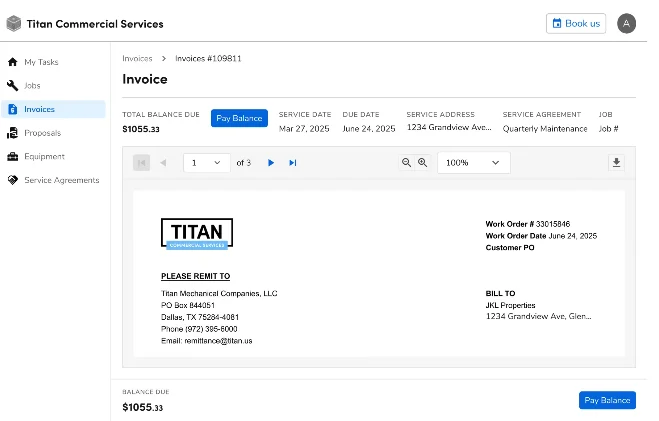
This feature gives clients the flexibility to book when it’s convenient for them, which in turn reduces the volume of incoming calls for your customer service representatives.
As a result, it frees staff to focus on higher-value tasks, such as complex service requests that can’t be solved through a phone call.
That’s not all—once scheduled, ServiceTitan automatically sends proactive text and email notifications to keep customers informed about technician details, arrival windows, or changes to the schedule.


This transparency is greatly appreciated by your customers, increasing their satisfaction and reducing no-shows, while alleviating the burden for your office staff.
Mobile Field App
ServiceTitan’s Field App lets you upload your own forms and pricebooks and helps teams secure more sales and get rid of outdated clipboards.
The App also equips techs with the information they need while in the field, reducing the back-and-forth between them and the office. Techs can quickly access client and equipment history, giving them context on past repairs, warranties, and recurring issues.

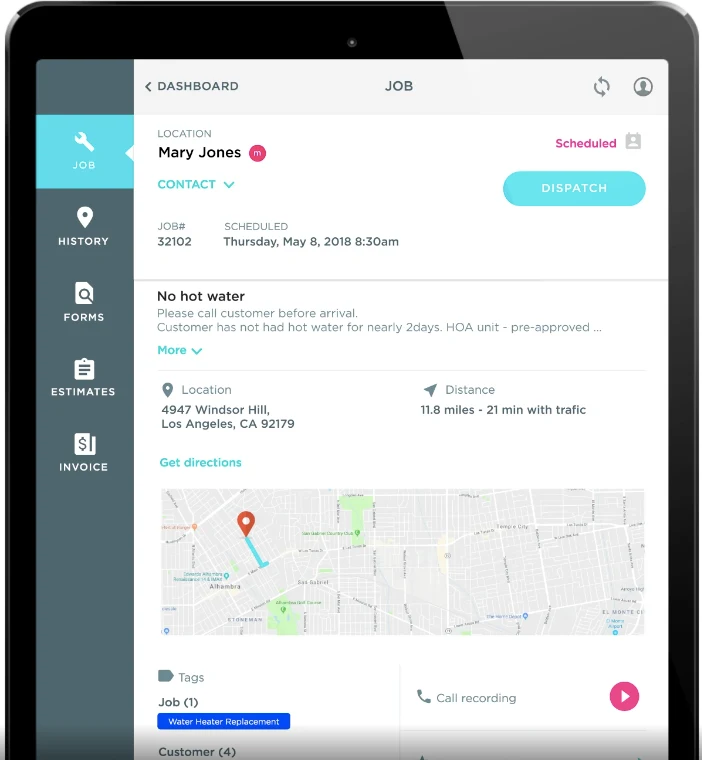
It also allows them to complete digital forms on-site, eliminating paperwork and ensuring accurate records for billing. Moreover, if techs lose or forget an important document, they’ll find it in the app immediately.
ServiceTitan Mobile allows companies to build estimates directly from the pricebook items or proposal templates. They can browse photos, videos, and product information to build a personalized estimate for the customer. As for the customer, they get a clear, professional option right on the spot, which helps speed up the decision process.
Visibility & Back-Office Efficiency
With ServiceTitan, people in the trades can enhance back-office operations by using real-time dashboards and technician scorecards that track performance across the business.


Through this dashboard, managers can see which techs are performing well, identify bottlenecks, and monitor service quality. If someone falls short of required standards, companies can enable data-driven coaching and new training opportunities.
Scorecards are not only for technicians, but also allow office staff to track metrics like first-time fix rates, average job duration, and customer satisfaction scores.
With these insights, you can determine where crews can take on more work (without overwhelming them) or might need additional support. In addition, by highlighting trends, businesses can reduce callbacks, optimize scheduling, and improve customer service.
How Can HVAC Businesses Future-Proof Themselves?
To combat the HVAC technician shortage, businesses must take a proactive approach to recruiting younger people and retaining existing staff.
Investing in technology such as ServiceTitan streamlines workflows, allowing techs to do their job more efficiently. Moreover, developing strong training programs, creating clear career paths, and providing flexible schedules will help attract skilled staff.
Companies that use these strategies can reduce burnout and adapt quickly to industry changes, creating the path to a more sustainable future.
ServiceTitan is the perfect platform for home service businesses that want centralized scheduling, dispatching, and analytics—all in one place. It aids in maximizing technician efficiency, streamlining workflows, tracking tech performance, and gaining actionable insights to improve operations.


ServiceTitan HVAC Software
ServiceTitan is a comprehensive HVAC business software solution built specifically to help service companies streamline their operations, boost revenue, and achieve growth. Our award-winning, cloud-based platform is trusted by more than 100,000+ contractors across the country.


